🐶 Labomaru’s Quick Take & Specs
“Cohere Parse 5 completely eliminates the latency and fragility of multi-stage OCR pipelines! You can now convert complex enterprise PDFs, slides, and scans into rich Markdown in a single pass. 🐶⚡”
- 🚀 Tool Type: Frontier Breakthrough / Enterprise Vision Model
- 💰 Cost & Pricing: $1.50 per 1,000 pages (API) | Dedicated Model Vault from $4.00/hr ($2,500/mo)
- 💻 System Requirements: Cloud API (AWS SageMaker / Microsoft Foundry) OR Local/Dedicated GPU (~4.6GB footprint)
- 🎯 Best For: Data Engineers, RAG Pipeline Architects, Enterprise Automation Developers
- ✨ Key Benefit: Cuts document ingestion workflow complexity by extracting tables, key-values, and bounding boxes without separate OCR steps!
1. Key Takeaways & Real-World Impact (Before vs. After)
Traditional enterprise Retrieval-Augmented Generation (RAG) and document processing workflows rely on multi-tier pipelines. Systems typically stitch together traditional OCR engines (like Tesseract or cloud document intelligence services), layout analysis models, and secondary LLM clean-up passes. This multi-step approach introduces compounding errors, high execution latency, and skyrocketing per-page costs.
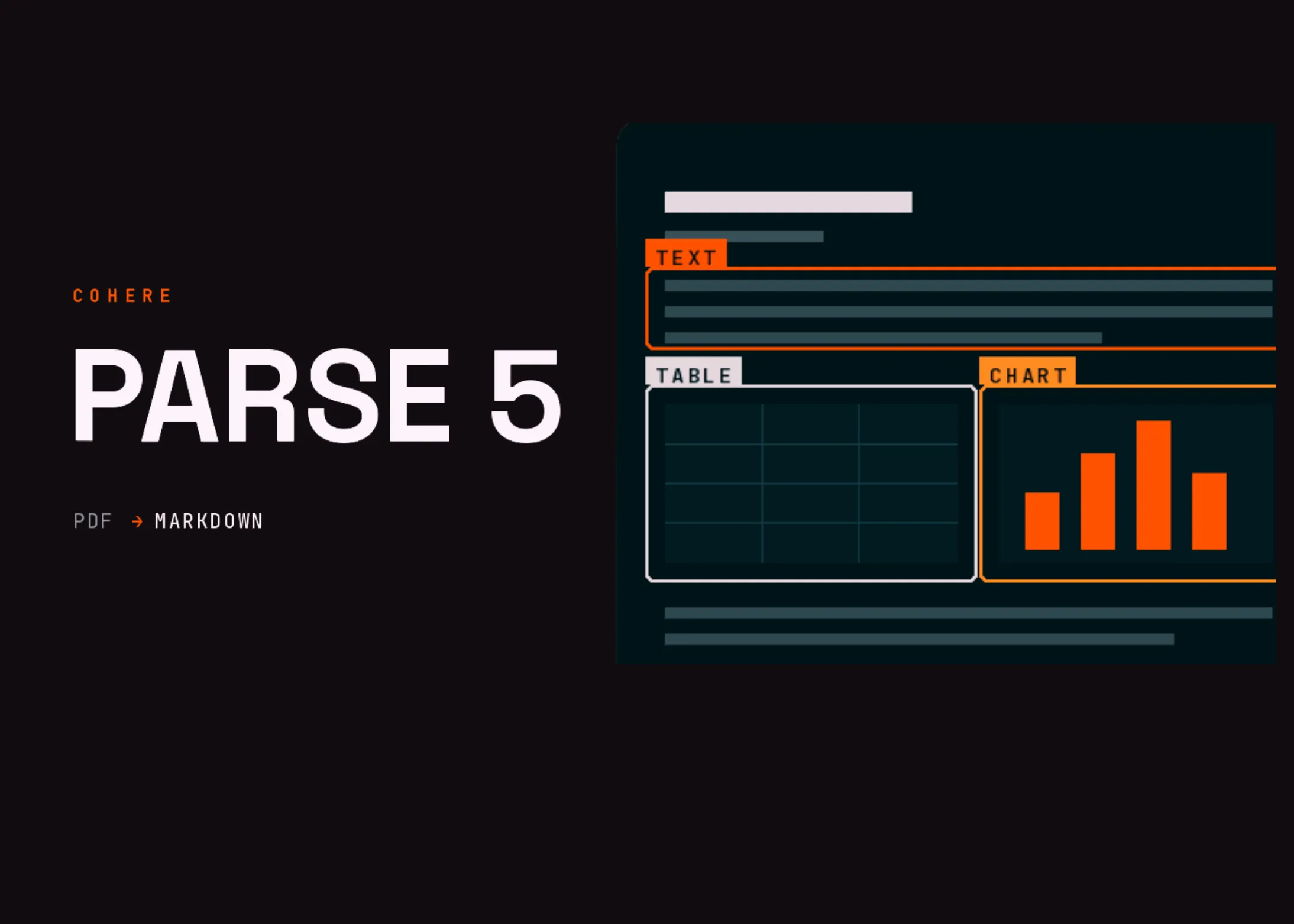
Cohere Parse 5 (parse-v5.0) fundamentally changes this paradigm. Built on the 2.3-billion parameter North-Micro-Vision-Instruct architecture, it ingests document images, PDFs, or PPT slides via base64 encoding and outputs directly structured Markdown in a single inference pass.
- Before: Multi-stage ingestion pipelines requiring separate OCR engines, custom heuristic layout parsers, and re-formatting LLM prompts. High brittle failure rate on complex multi-column layouts and financial tables.
- After: Direct end-to-end transformation from raw document page to clean Markdown, including embedded HTML tables, key-value mappings, list elements, visual image descriptions, and exact bounding boxes for full source traceability.
2. Hardware Specs, Pricing & Setup Complexity
Parse 5 balances enterprise performance with compact deployment requirements. The model footprint is remarkably lightweight at approximately 4.6GB, enabling deployment on mid-range hardware as well as managed enterprise infrastructure.
Technical Specifications
- Model Size: 2.3 Billion Parameters (North-Micro-Vision-Instruct)
- Context Window: 8,192 tokens
- Memory Footprint: ~4.6 GB
- Multilingual Support: 9 core stable languages (Arabic, English, French, German, Italian, Japanese, Korean, Portuguese, Spanish)
- Supported Inputs: PDF, PPT, JPEG (base64-encoded)
- Output Format: Structured Markdown, HTML tables, visual descriptions, bounding box JSON blocks
- Licensing: General Availability (GA), production-ready with no research license restrictions or waitlists
Deployment Options & Pricing Structure
- Pay-As-You-Go API: $1.50 per 1,000 processed pages (Free trial API keys available).
- Dedicated Single-Tenant Model Vault:
- Medium Instance: $4.00 / hour ($2,500 / month flat rate).
- XL Instance: $7.00 / hour ($4,300 / month flat rate).
- Cloud Ecosystems: Available out-of-the-box on Microsoft Foundry, AWS SageMaker, Cohere Parse API, and Hugging Face weights for private hosting.
Setup complexity is standard for REST API integration (1-Click cloud endpoints or standard CLI deployment for Hugging Face weights).
3. Comparative Analysis & Benchmarks (Including Break-Even Analysis)
In standard benchmark evaluations using ParseBench (vendor-reported 3-dimensional average across table accuracy, content accuracy, and semantic formatting), Cohere Parse 5 outperforms legacy cloud vision parsers and hybrid OCR models.
ParseBench Performance Benchmark
| Solution | Architecture | ParseBench 3D Average Score | Base API Pricing (per 1k pages) | OCR Pre-Pass Required? |
|---|---|---|---|---|
| Cohere Parse 5 | 2.3B Vision-Language (Single Pass) | 79.2 | $1.50 | No |
| Mistral OCR 4 | Vision-Language Hybrid | 74.5 | ~$2.00 | No |
| Azure Document Intelligence | Multi-Stage Cloud OCR | 74.3 | ~$1.50 - $10.00 | Yes |
| Databricks AI Parse | Hybrid Pipeline Engine | 72.4 | Custom Compute | Yes |
Financial Break-Even Analysis: API vs. Dedicated Vault
For enterprise data ingestion, choosing between the pay-as-you-go API and a dedicated single-tenant Model Vault Medium instance ($2,500/month) depends directly on monthly processing volume:
$$\text{Break-Even Volume} = \frac{$2,500}{$0.0015 \text{ / page}} \approx 1,666,667 \text{ pages/month}$$
- Under 1.66M pages/month: Cohere API ($1.50/1k pages) provides maximum cost efficiency without idle capacity overhead.
- Over 1.67M pages/month: Single-Tenant Model Vault Medium ($2,500/month fixed) yields lower marginal per-page costs and enhanced enterprise data isolation.
4. Pro Tips & Maximum Productivity Recipes
To integrate Parse 5 into a RAG pipeline with high traceability, leverage its bounding box capabilities to map parsed Markdown directly to original visual coordinates.
Python API Implementation Recipe
import base64
import requests

def parse_document_page(file_path: str, api_key: str):
    with open(file_path, "rb") as f:
        encoded_image = base64.b64encode(f.read()).decode("utf-8")

    headers = {
        "Authorization": f"Bearer {api_key}",
        "Content-Type": "application/json"
    }

    payload = {
        "model": "parse-v5.0",
        "document": {
            "type": "base64",
            "media_type": "image/jpeg",
            "data": encoded_image
        },
        "options": {
            "extract_tables_as_html": True,
            "include_bounding_boxes": True
        }
    }

    response = requests.post("https://api.cohere.com/v1/parse", json=payload, headers=headers)
    return response.json()

# Example execution
# result = parse_document_page("financial_report_page1.jpg", "YOUR_COHERE_API_KEY")
# print(result["markdown"])
- Prompt Hack for Chunking: Combine the extracted Markdown HTML tables directly into your vector database chunks. Because Parse 5 formats complex nested headers into valid HTML table elements, standard LLM chunkers retain semantic context much better than raw TSV or text representations.
5. Potential Pitfalls & Edge Cases
While Parse 5 excels at structured document conversion, technical leaders should be aware of specific constraints:
- 8,192 Token Context Constraint: For exceptionally dense multi-page documents or highly complex graphics, passing entire multi-page books in a single call will exceed the token budget. Documents should be split per page or per logical visual section prior to processing.
- Handwriting & Low-DPI Artifacts: Scanned documents below 150 DPI or heavy cursive handwriting may show reduced extraction accuracy compared to native digital PDFs and high-resolution slide decks.
- Local Deployment VRAM Allocation: Hosting the ~4.6GB model locally via Hugging Face requires dedicated GPU memory for batched production throughput. High-concurrency environments require multi-GPU setups.
6. Final Verdict & Cost-Benefit Recommendation
Cohere Parse 5 represents a major milestone for document intelligence. By consolidating vision recognition and Markdown synthesis into a single 2.3B model, it drastically reduces compute overhead while improving semantic parsing accuracy.
- Immediate Adoption: Recommended for RAG developers, fintech platforms processing balance sheets, and enterprises ingesting large volumes of mixed-media documents (PDF/PPT).
- Deployment Strategy: Start with the $1.50/1k pages API for rapid prototyping. Scale to dedicated single-tenant Model Vault instances once monthly ingestion crosses 1.67M pages.