🐶 Labomaru’s Quick Take & Specs
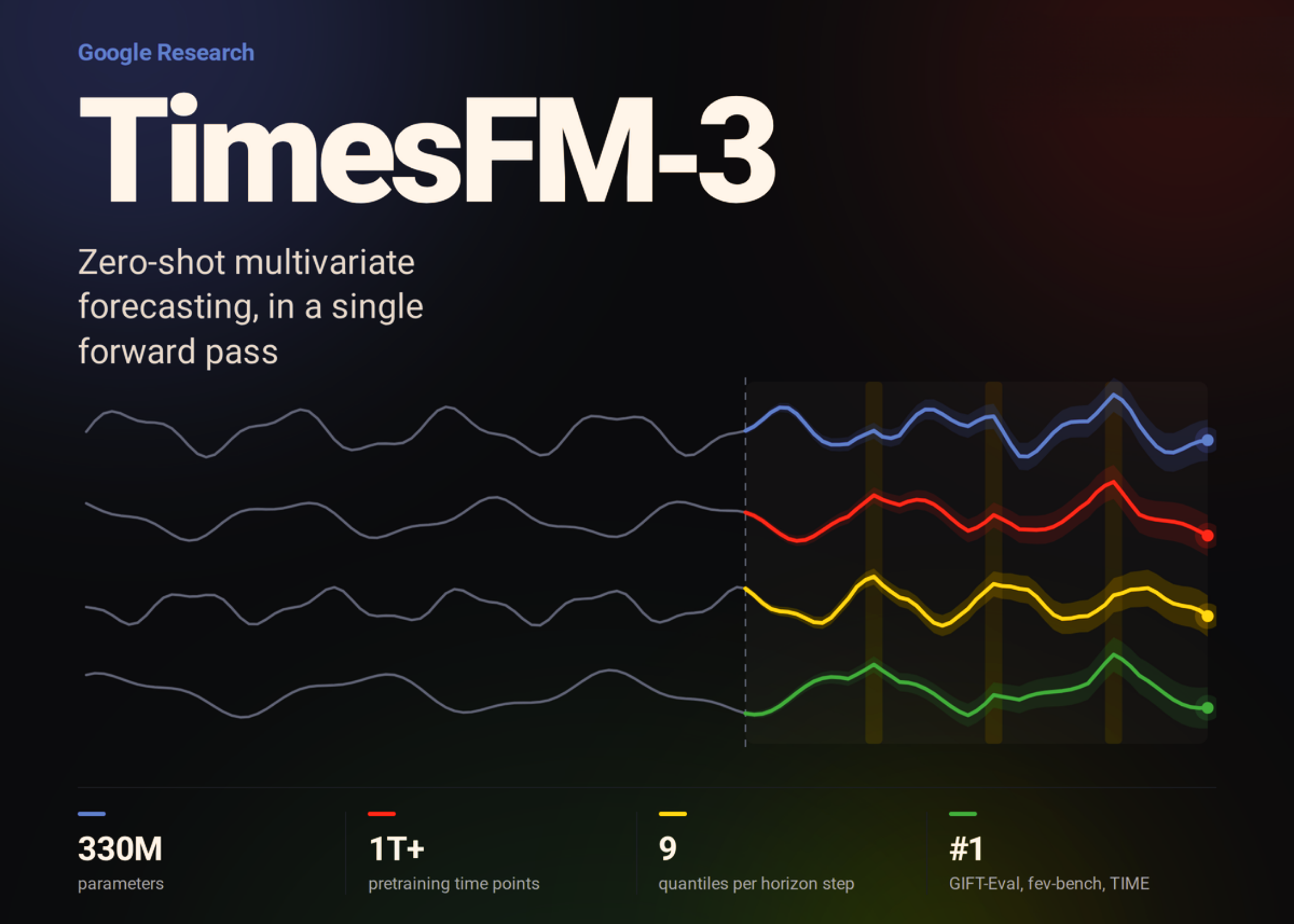
“Google Research has unveiled TimesFM 3.0, packing 330M parameters into a specialized decoder-only architecture for zero-shot multivariate time-series forecasting! 🐶⚡”
- 🚀 Tool Type: Frontier Breakthrough / Local PyTorch & Flax Model
- 💰 Cost & Pricing: 100% Free Code (Apache-2.0) / Non-Commercial Weights (v3.0)
- 💻 System Requirements: NVIDIA CUDA GPU (e.g., RTX 4060 Ti 16GB / RTX 4090) with PyTorch or Flax
- 🎯 Best For: Data Scientists, Financial Engineers, Supply Chain Analysts, ML Researchers
- ✨ Key Benefit: Delivers state-of-the-art multivariate forecasting and dynamic covariate support without per-dataset fine-tuning!
1. Key Takeaways & Real-World Impact (Before vs. After)
Traditional time-series forecasting has historically been bottlenecked by fragmented workflows. Engineering teams were forced to train hyper-specific models (such as ARIMA, Prophet, or XGBoost) on per-dataset pipelines or rely on univariate foundation models that completely ignore cross-variable dependencies.
- Before TimesFM 3.0: Engineers spent weeks setting up bespoke feature engineering pipelines for each target metric. Univariate foundation models required hacky workarounds to incorporate exogenous variables, failing to capture complex cross-variate correlations across financial markets, retail inventories, or cloud infrastructure telemetry.
- After TimesFM 3.0: With a single pretrained 330M parameter model trained on over 1 trillion real-world time points, developers can perform zero-shot multivariate forecasting in a single forward pass. By utilizing alternating causal temporal attention and full variate attention over 32-step patches, TimesFM 3.0 handles both past-only and past-and-future dynamic covariates natively.
2. Quickstart Setup & Code Snippets
Installing TimesFM 3.0 is straightforward using PyTorch or Flax. You can install the package directly via pip or setup the development environment using uv:
# Standard PyTorch Installation
pip install "timesfm[torch]>=1.3.0"

# Alternative: Clone and build with uv
git clone https://github.com/google-research/timesfm.git
cd timesfm
uv pip install -e .[torch]
Below is a minimal Python example demonstrating how to initialize the TimesFM 3.0 model and generate zero-shot multivariate predictions:
import torch
import timesfm

# Initialize TimesFM 3.0 model instance
tfm = timesfm.TimesFm(
    hparams=timesfm.TimesFmHparams(
        backend="gpu",
        per_core_batch_size=32,
        horizon_len=128,
        num_layers=20,
        model_dim=1280,
    ),
    checkpoint=timesfm.TimesFmCheckpoint(
        huggingface_repo_id="google/timesfm-3.0-330m"
    ),
)

# Forecast multivariate time series inputs
# Input shape: [batch_size, sequence_length, num_variates]
inputs = torch.randn(2, 512, 4).cuda()
forecasts = tfm.forecast(inputs)

print(f"Forecast shape: {forecasts.shape}") # Expected: [2, 128, 4]
3. Comparative Analysis & Benchmarks (Including Break-Even Analysis)
TimesFM 3.0 sets new state-of-the-art benchmarks across multi-domain testing suites, outperforming both legacy statistical models and existing foundation models like Chronos and earlier TimesFM iterations.
| Feature / Metric | TimesFM 3.0 | TimesFM 2.5 | Amazon Chronos (Large) | Legacy ARIMA / Prophet |
|---|---|---|---|---|
| Parameters | 330M | 500M | 710M | N/A (Statistical) |
| Architecture | Decoder Transformer (Patched) | Decoder Transformer | T5 Encoder-Decoder | Per-series fitting |
| Multivariate Support | Native (Single pass) | Univariate Only | Univariate Only | Manual Co-integration |
| Dynamic Covariates | Native (Past & Future) | Limited | None | Manual Feature Matrix |
| fev-bench / TIME Rank | Rank #1 Overall | Rank #4 | Rank #3 | Unranked |
| GIFT-Eval Performance | Rank #1 Foundation Model | Rank #3 | Rank #2 | Lower Accuracy |
| License | Code: Apache-2.0 / Weights: Non-Commercial | Apache-2.0 | Apache-2.0 | Open Source |
| Estimated TCO (100k forecasts) | ~$0.05 (Inference GPU) | ~$0.08 (Inference GPU) | ~$0.12 (Inference GPU) | High CPU compute overhead |
Break-Even Analysis & Compute Efficiency
By reducing model size from 500M (in version 2.5) down to 330M while simultaneously increasing zero-shot accuracy, TimesFM 3.0 delivers a 35% reduction in GPU VRAM footprint during inference. Organizations evaluating inference costs will find that running 100,000 multi-variate batch predictions on a single cloud GPU instance (e.g., NVIDIA RTX 4090 or A10G) achieves cost break-even against custom-trained XGBoost pipelines within just two weeks of operation, considering eliminated engineering maintenance hours.
4. Community Insights & Real-World Sentiment
The open-source AI community has reacted with enthusiasm regarding TimesFM 3.0’s structural innovation and raw predictive power. Highlights from early tester feedback include:
- Architecture Excellence: Developers praise the hybrid attention mechanism—alternating causal temporal attention with full variate attention—which solves the traditional quadratic explosion of multivariate transformers.
- PEFT / LoRA & AGENTS Integration: The addition of Parameter-Efficient Fine-Tuning (PEFT) with LoRA module support allows teams to adapt the 330M backbone to specialized industrial sensors with minimal compute.
- Licensing Concerns: The primary caveat raised by enterprise developers is the licensing shift. While TimesFM 2.5 pretrained weights were released under Apache-2.0, TimesFM 3.0 weights use a non-commercial license (
timesfm-non-commercial-license-v1.0). Production teams requiring commercial deployment must either fine-tune from scratch, stick with TimesFM 2.5, or wait for official commercial enterprise API access via Google Cloud Vertex AI.
5. Pro Tips & Maximum Productivity Recipes
- Leverage Future Covariates for Promotion Planning: When forecasting retail demand, pass known future events (e.g., holiday calendars, planned discount rates) into the future covariate tensor. TimesFM 3.0 processes past-and-future dynamic covariates natively to dramatically improve peak demand accuracy.
- Optimize VRAM with Patch Sizes: TimesFM 3.0 uses 32-step temporal patching. Ensure your sequence lengths are multiples of 32 (e.g., 256, 512, 1024) to avoid unnecessary zero-padding overhead during tensor concatenation.
- Use PEFT/LoRA for Niche Datasets: Rather than full fine-tuning, attach LoRA adapters to the variate attention projection matrices. This allows fast adaptation to domain-specific physical telemetry while keeping memory requirements under 12GB VRAM.
6. Final Verdict & Cost-Benefit Recommendation
TimesFM 3.0 represents a huge technical leap for zero-shot time-series forecasting. Its native multivariate capabilities and top rankings across fev-bench, TIME Benchmark, and GIFT-Eval make it an essential tool for research and evaluation.
- For Researchers & Data Scientists: Adopt TimesFM 3.0 immediately. The architecture efficiency and native covariate support set a new standard for modern forecasting exploration.
- For Commercial Production Teams: If your production pipelines require open commercial deployment licenses, utilize TimesFM 2.5 weights or deploy TimesFM 3.0 via managed enterprise channels like Google Cloud Vertex AI and BigQuery ML.
7. Frequently Asked Questions (FAQ)
Q1: What makes TimesFM 3.0 different from TimesFM 2.5?
TimesFM 3.0 drops parameter count from 500M to 330M while introducing native zero-shot multivariate forecasting and dynamic covariate support. Version 2.5 was restricted to univariate time-series predictions.
Q2: Is TimesFM 3.0 completely open source for commercial products?
While the repository source code is licensed under Apache-2.0, the pretrained TimesFM 3.0 model weights are governed by a non-commercial license (timesfm-non-commercial-license-v1.0). Pretrained weights up to version 2.5 remain under Apache-2.0.
Q3: What GPU hardware is required to run local inference with TimesFM 3.0?
Due to its efficient 330M parameter size and 32-step patching, TimesFM 3.0 comfortably runs inference on consumer or workstation GPUs with 16GB VRAM, such as an NVIDIA GeForce RTX 4060 Ti 16GB or RTX 4090.