
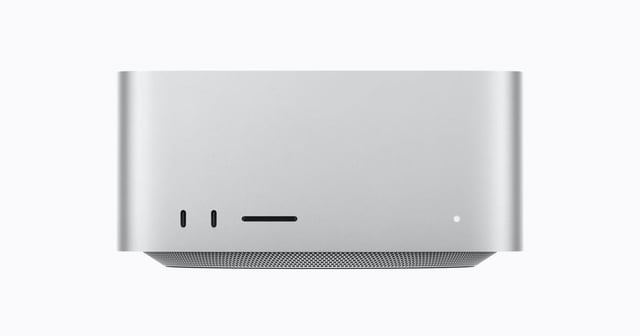
🐶 Labomaru’s Quick Take & Specs
“Running 405B open-weights models and DeepSeek-R1 locally on a silent desktop is no longer a dream! Apple’s M5 Ultra with 512GB unified memory completely reshapes local AI inference economics. 🐶⚡”
- 🚀 Tool Type: Ready for Local PC / Frontier Breakthrough
- 💰 Cost & Pricing: Enterprise Hardware ($7,999+ estimated base for 512GB configuration) / $0 Model Operating Fees
- 💻 System Requirements: M5 Ultra Mac Studio with 512GB Unified Memory
- 🎯 Best For: Enterprise AI Engineers, Privacy-Conscious Developers, Local LLaMA Enthusiasts
- ✨ Key Benefit: Runs 405B parameter LLMs locally with zero latency spikes, zero monthly API bills, and total data privacy!
1. Key Takeaways & Real-World Impact (Before vs. After)
Before the arrival of Apple’s M5 Ultra featuring up to 512GB of unified memory, running flagship open-source models like Meta’s Llama 3.1 405B or DeepSeek-R1 locally was restricted to massive multi-GPU server setups. Enterprise developers and researchers had to deploy multi-node clusters consisting of 4 to 8 NVIDIA H100 or A100 GPUs, drawing thousands of watts of power, generating server-rack heat and noise, or rely on expensive cloud API provider subscriptions with recurring monthly costs and stringent privacy trade-offs.
After this breakthrough release, a single compact, whisper-silent desktop hardware footprint can hold the entirety of massive frontier models in unified VRAM. Local inference for 405B parameter models quantized at FP8 or Q4/Q5 variants becomes feasible on a single machine. Teams can now achieve complete offline data autonomy, predictable fixed capital expenditure (CapEx) instead of exploding operational costs (OpEx), and sub-second prompt evaluation speeds without sending sensitive proprietary codebases or healthcare/financial data to third-party endpoints.
2. Hardware Specs, Pricing & Setup Complexity
The Mac Studio powered by M5 Max and M5 Ultra represents a quantum leap in memory architecture integration for workstation-class computing:
- Memory Capacity & Bandwidth: Configurations scale up to 512GB of unified memory with memory bandwidth exceeding 1.6 TB/s on the M5 Ultra tier.
- Compute Infrastructure: Built on advanced 3nm process nodes with up to 32 CPU cores and 80+ GPU cores, combined with accelerated Neural Engine matrix multiplication extensions tailored for transformer inference.
- Estimated Pricing:
- M5 Max Base (64GB RAM): ~$1,999
- M5 Ultra High-Spec (256GB RAM): ~$4,999
- M5 Ultra Max-Spec (512GB Unified Memory): ~$7,999 - $9,999
- Setup Complexity: CLI / Moderate (2 out of 5 difficulty). Running models requires installing open-source engines like
llama.cpp,Ollama, orMLXvia simple terminal commands (brew install ollama).
3. Comparative Analysis & Benchmarks (Including Break-Even Analysis)
To evaluate the true return on investment (ROI), we must contrast the M5 Ultra Mac Studio with custom multi-GPU liquid-cooled workstations and cloud API usage for enterprise teams processing high token volumes.
| Metric / Parameter | 4x NVIDIA RTX 4090 (96GB VRAM) | 8x NVIDIA H100 (640GB VRAM Cloud Rental) | Mac Studio M5 Ultra (512GB Unified Memory) |
|---|---|---|---|
| Max Model Capability | 70B - 120B Models | 405B / DeepSeek-R1 (FP16/FP8) | 405B / DeepSeek-R1 (Q4/FP8) |
| Initial CapEx Hardware | ~$10,000 - $14,000 | $0 (Cloud Rental) | ~$8,499 |
| Monthly Operational Cost | ~$150 - $300 (Electricity ~1.5kW) | ~$1,500 - $4,500 / month | ~$15 - $30 (Electricity ~250W) |
| Data Privacy & Offline | Full Local Autonomy | Cloud Risk / Third-party API | Full Local Autonomy |
| Acoustics & Power Draw | High Noise (~60dB), 1500W | Data Center Noise | Whisper Silent (~15dB), ~250W |
| Break-Even vs. Cloud | 8 - 12 Months | N/A (Continuous Monthly Expense) | 4 - 6 Months (vs. API spend of $1.5k/mo) |
Financial Break-Even Calculation:
Assuming a mid-sized software development team consumes 100 million tokens per month using commercial API endpoints (e.g., Claude 3.5 Sonnet or GPT-4o at ~$15/M tokens total):
- Annual Cloud API Spend: 100M tokens/mo × $15/M × 12 months = $18,000 / year.
- M5 Ultra Mac Studio 512GB CapEx: $8,499 one-time.
- Break-Even Point: Achieved in less than 6 months, yielding a net savings of over $9,500 in Year 1 alone.
4. Pro Tips & Maximum Productivity Recipes
To unlock maximum tokens per second (tok/s) on Apple Silicon, bypass standard PyTorch pipelines and utilize native Apple hardware abstractions:
Recipe 1: Native MLX Quantization Pipeline
Apple’s mlx-lm framework leverages metal performance primitives natively to achieve optimum memory bandwidth utilization.
# Install Apple Silicon native MLX framework
pip install mlx-lm

# Run quantized DeepSeek-R1 or Llama-3.1-405B directly using unified memory
mlx_lm.generate --model mlx-community/Meta-Llama-3.1-405B-Instruct-4bit \
                --prompt "Architect a distributed event-driven microservice system in Go." \
                --max-tokens 2048 --temp 0.2
Recipe 2: Ollama Setup for Multi-Developer Local API Server
Expose your local M5 Ultra as an OpenAI-compatible internal enterprise endpoint for your engineering team:
# Set environment variables for unified memory layer caching
export OLLAMA_NUM_PARALLEL=4
export OLLAMA_MAX_LOADED_MODELS=2

# Serve local DeepSeek-R1 70B/405B model across local network
ollama run deepseek-r1:405b-q4_K_M
5. Potential Pitfalls & Edge Cases
While 512GB of unified memory is a game-changer for local inference, potential buyers must consider key structural limitations:
- Inference Speed vs. Raw Compute (TFLOPS): Apple’s unified memory bandwidth (~1.6 TB/s) provides stellar speed for batch size 1-4 inference. However, for large-batch fine-tuning or massive parallel training, NVIDIA’s Tensor Core raw TFLOPS still dominate.
- Quantization Requirements: Fitting 405B parameter models inside 512GB requires 4-bit or 8-bit quantization (Q4_K_M or FP8). While degradation is minimal, mission-critical research requiring unquantized FP16 still needs >800GB VRAM.
- Non-Upgradable Hardware: Apple Silicon memory is permanently soldered. Purchasing a 256GB or 512GB model requires committing to the configuration upfront; you cannot add SODIMM modules or PCIe expansion cards later.
6. Final Verdict & Cost-Benefit Recommendation
- Immediate Buy: For enterprise R&D departments, privacy-restricted sectors (law, finance, healthcare), and independent AI engineers spending >$1,000/month on cloud LLM APIs. The M5 Ultra 512GB pays for itself within months while giving complete control over proprietary codebases.
- Consider Wait / Lower Spec: For hobbyists or individual developers running smaller models (<70B parameters). A standard M5 Max with 64GB or 128GB unified memory provides the sweet spot for running 8B to 70B models at a fraction of the cost ($2,000 - $3,500).


![[Early Report] DeepSeek V4.1 Flash Engineering Teardown: Dissecting MoE Efficiency and Benchmark Realities](/images/20260914183600.png)