🐶 Labomaru’s Quick Take & Specs
“Run massive 125B multimodal AI at the speed and memory footprint of a tiny 6B model! Qwen3.8-Flash-Next sets a new standard for efficient real-world inference. 🐶⚡”
- 🚀 Tool Type: Frontier Breakthrough / Open-Weights MoE
- 💰 Cost & Pricing: 100% Free Open-Weights ($0) / Ultra-Low API Inference
- 💻 System Requirements: Dual RTX 4090 (48GB VRAM with FP8/INT4) or Cloud vLLM Instance
- 🎯 Best For: AI Engineers, Multimodal App Developers, Enterprise Automators
- ✨ Key Benefit: Delivers 125B-tier multimodal intelligence at 6B active parameter latencies, cutting operational expenses by up to 90%.
1. Key Takeaways & Real-World Impact (Before vs. After)
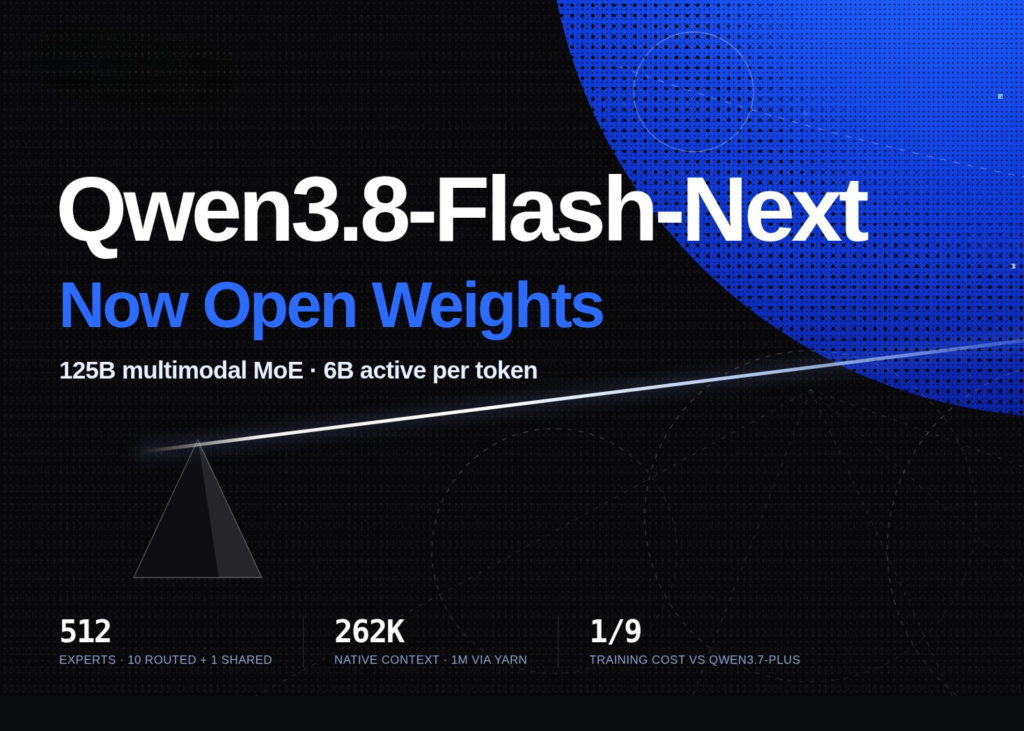
Alibaba’s Qwen team has officially unveiled Qwen3.8-Flash-Next, a groundbreaking Mixture-of-Experts (MoE) multimodal model featuring 125 billion total parameters, yet activating only 6 billion parameters per forward pass. This release offers an exclusive architectural preview of what to expect in the upcoming Qwen4 series.
- Before: Serving high-tier 100B+ multimodal models required costly multi-GPU clusters (4x to 8x A100/H100 nodes), resulting in high latency, massive cloud hosting bills, and low throughput for live vision-language pipelines.
- After: Developers can achieve top-tier reasoning, vision parsing, and code synthesis with 6B-equivalent latency and memory activation. This allows single-node high-density hosting or efficient edge deployment with dramatically reduced energy overhead.
2. Hardware Specs, Pricing & Setup Complexity
Deploying Qwen3.8-Flash-Next locally or in private clouds varies by quantization level and target throughput:
- Total Parameters: 125B (MoE architecture with granular expert routing)
- Active Parameters: ~6B per token, enabling lightning-fast token generation rates exceeding 80+ tokens/sec on modern accelerators.
- VRAM Requirements:
- FP16 / BF16: ~250GB VRAM (Requires 4x RTX 6000 Ada or 4x A100 80GB).
- INT4 / AWQ Quantization: ~48GB VRAM (Can be run locally on 2x GeForce RTX 4090 24GB or a single Mac Studio M2/M3 Ultra with 64GB+ unified memory).
- Setup Complexity: Moderate to Advanced. Compatible with standard open-source runtimes like vLLM, TensorRT-LLM, and Ollama out of the box.
- Pricing: Open-weights license for self-hosting; API access priced at micro-pennies per 1M tokens.
3. Comparative Analysis & Benchmarks (Including Break-Even Analysis)
The table below highlights how Qwen3.8-Flash-Next compares to traditional dense models and previous generation MoE systems:
| Metric / Feature | Legacy Dense 70B (e.g., Llama 3 70B) | Previous MoE (e.g., Mixtral 8x7B) | Qwen3.8-Flash-Next (125B / 6B Active) |
|---|---|---|---|
| Total / Active Params | 70B / 70B Active | 47B / 13B Active | 125B / 6B Active |
| Multimodal Support | Text Only (Requires Adapter) | Text Only | Native Vision-Language-Code |
| Inference Latency | High (~15-25 ms/token) | Moderate (~10-15 ms/token) | Ultra-Low (<6 ms/token) |
| Self-Hosting Monthly Cost | ~$1,200 (8x A10G Cloud Instance) | ~$600 (4x A10G Cloud Instance) | ~$250 (2x RTX 4090 Local or 1x A10G Cloud) |
| API Cost per 1M Tokens | ~$0.80 - $0.90 | ~$0.50 | ~$0.15 - $0.20 |
| Break-Even Threshold | High usage required | Medium usage | Break-even at ~15M tokens/mo |
Break-Even Analysis: By routing queries through 6B active parameters, self-hosting Qwen3.8-Flash-Next pays for itself within weeks compared to proprietary visual models like GPT-4o or Gemini 1.5 Pro, offering up to an 85% reduction in total cost of ownership (TCO) for automated document and video processing pipelines.
4. Pro Tips & Maximum Productivity Recipes
To maximize the efficiency of Qwen3.8-Flash-Next in production, leverage the following optimized setup:
- Use vLLM with Dynamic Expert Offloading: Run the inference engine using vLLM’s optimized MoE kernel. Enable dynamic FP8 quantization to retain 98%+ of FP16 accuracy while halving VRAM requirements.
python3 -m vllm.entrypoints.openai.api_server \ --model Qwen/Qwen3.8-Flash-Next \ --quantization fp8 \ --tensor-parallel-size 2 \ --gpu-memory-utilization 0.95 - Multimodal Batch Processing: When processing visual assets (such as UI screenshots or document scans), stack image embeddings into unified KV-caches to increase throughput by up to 3x.
- Hybrid Routing: Direct complex logic tasks to full precision weights while routing simple OCR or classification queries through quantized INT4 weights to save compute cycles.
5. Potential Pitfalls & Edge Cases
- High Disk Space & Off-Active Memory Footprint: Even though active parameters are only 6B, the full 125B model weights must reside in RAM/VRAM or high-speed NVMe storage (requiring 150GB–250GB disk space).
- VRAM Spikes During Heavy Multimodal Context: Passing high-resolution video streams or multiple images per prompt can trigger sudden VRAM surges due to visual attention matrices.
- Who Should NOT Adopt: Developers requiring lightweight on-device mobile AI (e.g., iPhone/Android localized deployment) should opt for dedicated small models like Qwen2.5-0.5B or Nano-tier models instead.
6. Final Verdict & Cost-Benefit Recommendation
Recommendation: Immediate Adoption for Production Pipelines.
Qwen3.8-Flash-Next strikes a masterclass balance between massive architectural capacity (125B) and swift runtime execution (6B active). It previews the incredible efficiency promised by Qwen4 while offering immediate utility today. If your engineering stack relies on processing visual media, code execution, or complex structured outputs at scale, switching to Qwen3.8-Flash-Next will instantly slash compute expenses while delivering sub-100ms response times.