
🐶 Labomaru’s Quick Take & Specs
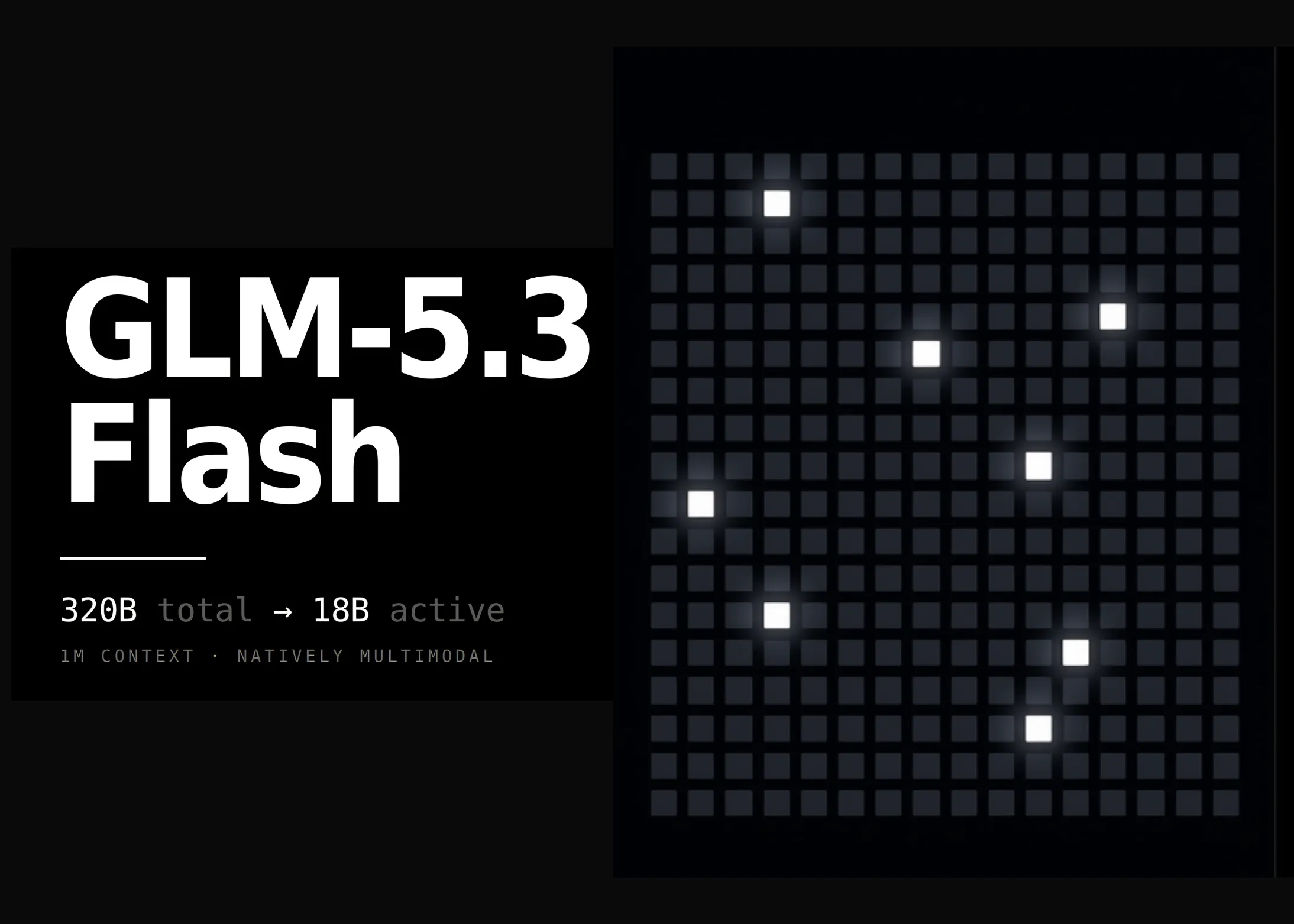
“GLM-5.3-Flash combines a 320B total parameter Mixture-of-Experts architecture with 18B active parameters and native multimodal 1M token context processing! 🐶⚡”
- 🚀 Tool Type: Frontier Breakthrough / Open-Weights AI Model
- 💰 Cost & Pricing: Open-Weights Available / Low-Cost API Inference
- 💻 System Requirements: Dual RTX 4090 (Quantized) or Cloud GPU Server (128GB+ VRAM for FP8)
- 🎯 Best For: Workflow Automators, AI Engineers, Enterprise Developers
- ✨ Key Benefit: Process entire books, dense codebase repositories, and high-res video streams in seconds with minimal active memory overhead!
1. Key Takeaways & Real-World Impact (Before vs. After)
Processing massive multimodal inputs—such as hour-long video files, multi-hundred-page technical manuals, or vast code repositories—traditionally required expensive proprietary APIs or complex multi-stage chunking algorithms.
- Before: Enterprise workflows relied on heavy chunking pipelines (RAG), which lost global contextual coherence. Developers faced escalating costs with closed APIs ($15-$30 per million input tokens for frontier multimodal models), slow generation latency, and severe memory bottlenecks when attempting local inference.
- After: GLM-5.3-Flash solves this trade-off using a 320B total parameter Mixture-of-Experts (MoE) design where only 18B parameters are active per token. With native 1M-token context length and multimodal support (text, image, audio, video), developers can feed complete datasets directly into the model at ultra-fast Flash-tier inference speeds.
2. Hardware Specs, Pricing & Setup Complexity
- Model Architecture: 320 Billion total parameters with 18 Billion active parameters (MoE).
- Context Window: 1 Million tokens with native cross-attention across vision and audio modalities.
- Local Hardware Requirements:
- Quantized (4-bit/8-bit): Dual NVIDIA RTX 4090 (48GB VRAM total) or Apple Mac Studio (128GB Unified Memory).
- Full Precision (FP8/FP16): Enterprise cluster with 4x to 8x NVIDIA A100/H100 80GB GPUs.
- Cloud API Pricing: Estimated $0.10 - $0.30 per million input tokens, delivering up to 80% cost reduction compared to proprietary frontier models.
- Setup Difficulty: Intermediate (CLI / vLLM / Ollama). Running locally requires tensor parallelism setup using frameworks like vLLM or SGLang.
3. Comparative Analysis & Benchmarks (Including Break-Even Analysis)
The table below compares GLM-5.3-Flash against standard open-weights MoE models and commercial closed-source APIs:
| Feature / Metric | GLM-5.3-Flash | Mixtral 8x22B | GPT-4o / Claude 3.5 Sonnet |
|---|---|---|---|
| Total / Active Params | 320B / 18B | 141B / 39B | Undisclosed (Dense/MoE) |
| Context Window | 1,000,000 Tokens | 64,000 Tokens | 128,000 - 200,000 Tokens |
| Native Multimodality | Text, Image, Video, Audio | Text / Code Only | Text, Vision, Audio |
| API Input Cost / 1M | ~$0.15 | ~$0.60 | $2.50 - $3.00 |
| Local Host Feasibility | High (18B active MoE) | Moderate (39B active MoE) | Impossible (Closed API) |
| Break-Even Point | ~150M tokens/month | ~400M tokens/month | N/A (Pay per request) |
Total Cost of Ownership (TCO) & Break-Even Analysis
For an organization processing 500 million multimodal tokens per month, relying on closed APIs costs roughly $1,250 to $1,500/month. Self-hosting GLM-5.3-Flash on a dedicated dual-A10G or dual-RTX 4090 cloud instance (~$350/month) achieves a break-even point in under 25 days, cutting operational AI bills by over 70% while ensuring strict data privacy.
4. Pro Tips & Maximum Productivity Recipes
Recipe 1: Whole-Codebase Bug Auditing
Pass an entire compressed source folder into the context window with a structured instruction:
[CONTEXT: Insert complete source code across 40 files]
TASK: Identify memory leaks, unhandled exceptions, and security vulnerabilities.
OUTPUT FORMAT:
1. Summary of Risk Level
2. File Path & Line Numbers
3. Optimized Refactored Code Snippet
Recipe 2: Native Video Feature Extraction
Rather than sampling frames into separate vision-language pipelines, feed short instructional MP4 videos directly into GLM-5.3-Flash to generate step-by-step technical documentation with exact timestamp citations.
5. Potential Pitfalls & Edge Cases
- VRAM Spikes During KV Cache Fill: Although active parameter memory is low (18B), maintaining a 1M token KV cache requires significant VRAM. Deploying flash-attention-3 or vLLM PagedAttention is mandatory to avoid Out-Of-Memory (OOM) errors.
- Sparsity Overhead on Single Consumer GPUs: Single consumer GPUs (like a single 16GB RTX 4060 Ti) cannot store all 320B routing weights. Local execution requires multi-GPU arrangements or unified memory Macs.
- Who Should NOT Buy Local Hardware?: Developers processing fewer than 10 million tokens per month should stick to API endpoints rather than investing in multi-GPU hardware setups.
6. Final Verdict & Cost-Benefit Recommendation
GLM-5.3-Flash represents a major architectural milestone for high-efficiency AI. By pairing a massive 320B parameter pool with light 18B active token routing and 1M context capabilities, it offers frontier-class intelligence at a fraction of the hardware budget.
- Immediate Adoption: Recommended for enterprise teams looking to build privacy-first document analysis pipelines or low-latency video context systems.
- Wait & Evaluate: Recommended for individual hobbyists without access to 48GB+ VRAM setups or cloud GPU subscriptions.