🐶 Labomaru’s Quick Take & Specs
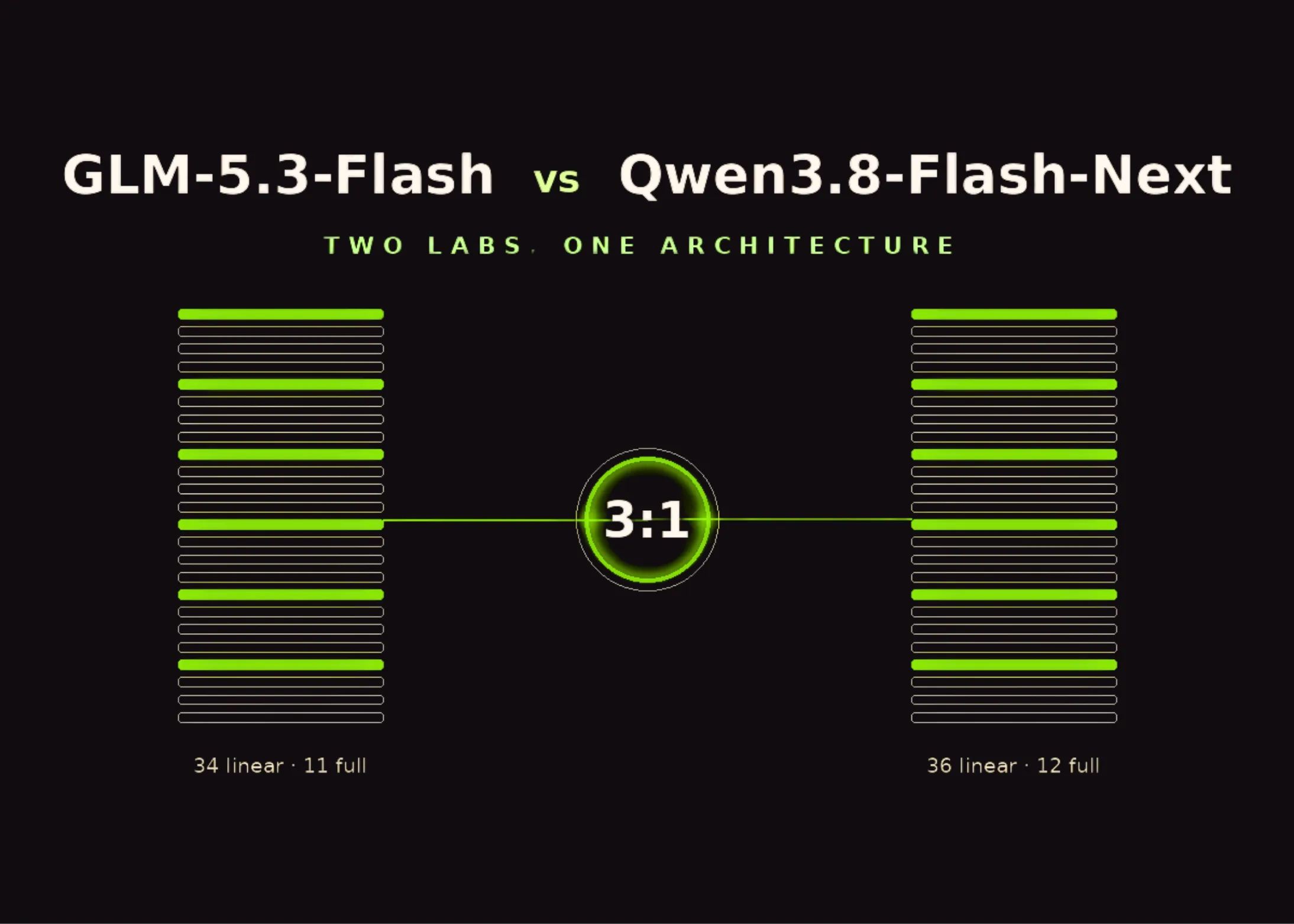
“Two leading AI research labs independently converged on the exact same 3:1 linear-to-full attention hybrid architecture! Achieve near Claude-level reasoning at 1/10th the inference cost. 🐶⚡”
- 🚀 Tool Type: Frontier Open-Weight Breakthrough & High-Speed API
- 💰 Cost & Pricing: Open Weights ($0) / API ($0.15/1M Input, $0.50/1M Output)
- 💻 System Requirements: 8x A100/H100 Cloud GPU for self-hosting OR Instant API Access via OpenRouter / vLLM
- 🎯 Best For: Enterprise Developers, AI System Architects, High-Throughput Agentic Workflows
- ✨ Key Benefit: Slashes KV cache memory by 4.4x and prefill latency by up to 7.6x while preserving top-tier coding performance.
1. Key Takeaways & Real-World Impact (Before vs. After)
Deploying ultra-long-context models for enterprise code generation and automated agentic loops has historically been prohibitively expensive. Traditional full attention architectures scale quadratically ($O(N^2)$) in compute and memory requirements as token lengths increase, bottlenecking generation speeds and driving cloud hardware budgets out of control.
- Before (Legacy Full Attention LLMs): Processing 1M token contexts required massive GPU cluster allocations running full self-attention layers. KV cache size consumed hundreds of gigabytes per concurrent user session, leading to steep cloud billing ($3.00+ per 1M tokens) and slow token generation during long agent execution trace loops.
- After (GLM-5.3-Flash & Qwen3.8-Flash-Next): By replacing 75% of traditional attention layers with high-throughput linear layers (Gated DeltaNet / linear recurrent structures in a 3:1 ratio), KV cache requirements drop by 4.4x while prefill speed jumps by up to 7.6x. Organizations achieve performance approaching top commercial models like Claude Opus 4.8 at an API cost of just $0.15/1M input tokens.
2. Hardware Specs, Pricing & Setup Complexity
Both Z.ai and Alibaba Qwen team arrived at identical micro-architectural parameters: a 3:1 linear-to-full attention ratio, 4-branch gated residual streams, 4x indexer compression capped at 2,048 tokens, and component-split Muon optimization.
- GLM-5.3-Flash: Features a 320B parameter multimodal Mixture-of-Experts (MoE) engine with 18B active parameters per token. Native 1M context window out of the box. Released under the permissive MIT License.
- Qwen3.8-Flash-Next: Combines a 125B base model (6B active parameters) with a 51B n-gram embedding table for instant token lookup. Native 262k context extensible to 1M via YaRN. Distributed as open-weights on Hugging Face and GitHub.
- Deployment & Hardware Footprint: Self-hosting full unquantized FP16 checkpoints requires enterprise GPU nodes (e.g., 8x NVIDIA A100 80GB or H100). For local developer testing, quantized 4-bit variants can be hosted using vLLM on multi-GPU workstation setups, while production workloads leverage low-cost cloud APIs.
3. Comparative Analysis & Benchmarks (Including Break-Even Analysis)
The operational efficiencies unlocked by hybrid linear architecture redefine the total cost of ownership (TCO) for automated software engineering and dynamic document processing.
| Feature / Metric | GLM-5.3-Flash | Qwen3.8-Flash-Next | Traditional 300B+ Full Attention | Commercial API (Claude Class) |
|---|---|---|---|---|
| Active Parameters | 18B (out of 320B MoE) | 6B (out of 125B + 51B table) | ~300B Dense / 30B MoE | Proprietary |
| Layer Ratio | 34 Linear : 11 Full (3:1) | 36 DeltaNet : 12 QSA (3:1) | 0 Linear : 48 Full (0:1) | Proprietary Full Attention |
| KV Cache Compression | 4.4x Reduction | Up to 4.9x Reduction | 1.0x (Baseline) | Standard Baseline |
| Prefill Speedup (1M Context) | ~3.0x Fast Prefill | 7.6x Fast Prefill | 1.0x (Baseline) | Variable Latency |
| Input Cost / 1M Tokens | $0.15 | Open Weight ($0 local) | ~$1.50 - $3.00 | $3.00 - $15.00 |
| Output Cost / 1M Tokens | $0.50 | Open Weight ($0 local) | ~$5.00 - $10.00 | $15.00 - $75.00 |
Break-Even & TCO Analysis
Running 10,000 long-context agentic pipeline runs (averaging 500k context window per run) on legacy APIs costs approximately $15,000 to $30,000. Switching to GLM-5.3-Flash cloud APIs reduces this workload expense to approximately $750, representing a 95% reduction in API spend. For local self-hosting of Qwen3.8-Flash-Next on an owned 8x A100 server node, hardware payback break-even is achieved within 4 months of heavy production load.
4. Pro Tips & Maximum Productivity Recipes
Recipe 1: vLLM Hybrid Engine Serving Setup
To serve Qwen3.8-Flash-Next using vLLM, configure the linear attention kernel offloading to optimize throughput during long-context processing:
# Install the latest vLLM recipe with Gated DeltaNet support
pip install vllm --upgrade

# Launch server with tensor parallelism across 4 GPUs
python3 -m vllm.entrypoints.openai.api_server \
    --model Qwen/Qwen3.8-Flash-Next \
    --tensor-parallel-size 4 \
    --max-model-len 262144 \
    --gpu-memory-utilization 0.92 \
    --enable-chunked-prefill
Recipe 2: Python Inference Client Request
Once your local vLLM server is active, execute high-throughput batch queries using standard OpenAI-compatible client code:
import openai

# Point client to local vLLM server instance
client = openai.OpenAI(
    base_url="http://localhost:8000/v1",
    api_key="EMPTY"
)

response = client.chat.completions.create(
    model="Qwen/Qwen3.8-Flash-Next",
    messages=[
        {"role": "system", "content": "You are an expert AI code auditor specializing in high-performance computing."},
        {"role": "user", "content": "Analyze this repo structure for linear-attention optimization opportunities."}
    ],
    temperature=0.2,
    max_tokens=1024
)

print(response.choices[0].message.content)
Recipe 3: Prompt Structuring for 3:1 Hybrid Models
Because hybrid linear models rely on 1/4th full attention layers to compress contextual history, position key system instructions and code base definitions at the beginning of the context window, and anchor final queries near the tail:
Prompt Structure:
  1. Core System Role & Directives (Indices 0 - 2000 tokens)
  2. Dense Data & Code Context (Linear Recurrent Memory Stream)
  3. Explicit Recall Anchors & Output Schemas (Tail Full Attention Window)
5. Potential Pitfalls & Edge Cases
- Dense Needle-in-a-Haystack Degradation: While 3:1 linear-hybrid models excel at standard code generation and reasoning, extreme needle-in-a-haystack tasks buried deep within 1M tokens of unstructured narrative data can show minor retrieval drop-offs compared to 100% full-attention models.
- Cold-Start Latency for N-Gram Tables: Qwen3.8-Flash-Next relies on a 51B parameter n-gram embedding table. Loading this table into VRAM during cold starts or host reboots requires fast NVMe storage bandwidth.
- Consumer GPU Constraints: Although active parameter counts are low (6B-18B), the total parameter weights (125B-320B) still require substantial memory allocation. Developers attempting to run these models locally on single consumer GPUs (e.g., 16GB VRAM) must use heavy 4-bit/3-bit quantization or rely on remote API endpoints.
6. Final Verdict & Cost-Benefit Recommendation
- For Enterprise Developers & Engineering Leads: Adopt immediately. Migrating long-context coding pipelines and automated QA agents to GLM-5.3-Flash or self-hosted Qwen3.8-Flash-Next provides immediate 10x compute cost savings without degrading reasoning quality.
- For Independent Builders: Utilize OpenRouter or direct API providers for GLM-5.3-Flash ($0.15/1M input). It eliminates the barrier of needing high-end local GPU rigs while delivering state-of-the-art inference speeds.
- Verdict: The 3:1 linear attention hybrid is no longer an experimental architecture—it is the new industry benchmark for scalable intelligence.
7. Frequently Asked Questions (FAQ)
Q1: What is the key architectural shift in GLM-5.3-Flash and Qwen3.8-Flash-Next?
Both models adopt a 3:1 linear-to-full attention hybrid architecture, combining Gated DeltaNet or linear attention layers with full self-attention to slash KV cache memory usage by 4.4x and accelerate prefill speeds up to 7.6x.
Q2: Can I run Qwen3.8-Flash-Next locally on consumer hardware?
While full unquantized models require enterprise multi-GPU nodes (e.g., 8x A100), 4-bit quantized variants can be hosted locally on workstations equipped with high-VRAM cards like the NVIDIA RTX 4090.
Q3: How does the API pricing compare to legacy full-attention frontier models?
At $0.15 per 1M input tokens, GLM-5.3-Flash is up to 20x cheaper than legacy full-attention models like Claude Opus, enabling high-throughput long-context workflows at a fraction of the budget.