🐶 Labomaru’s Quick Take & Specs
“By unifying ASR, diarization, and endpointing into a single 80ms chunked autoregressive loop, Meta cuts multi-stage streaming pipeline friction. Just remember: zero local weights mean complete cloud dependency! 🐶⚡”
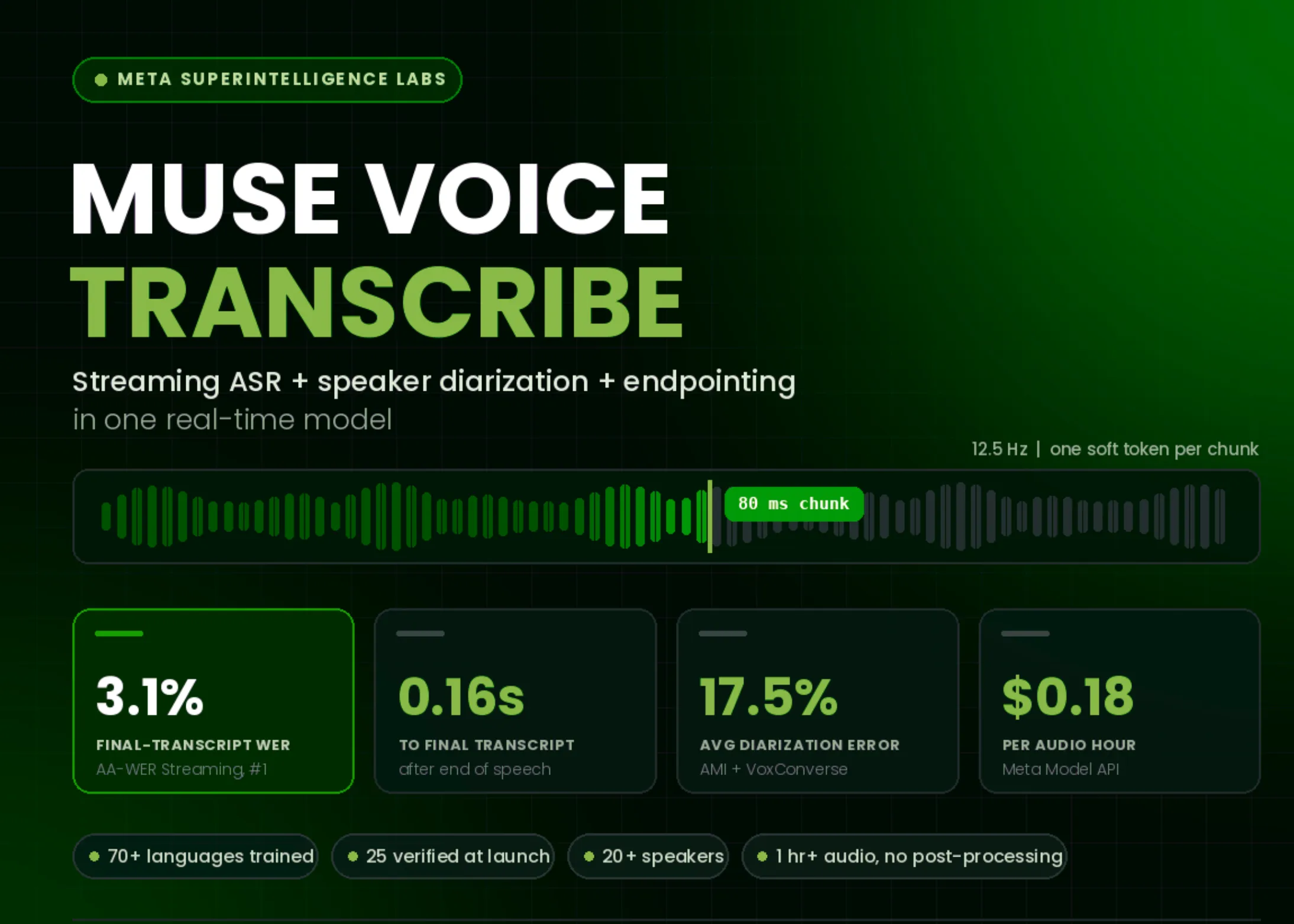
- 🏢 Developer / Lab: Meta Superintelligence Labs
- 🧠 Architecture: Muse Spark Autoregressive Multimodal (80ms / 12.5Hz Chunks)
- 💻 Deployment Target: Meta Model API (Cloud Endpoint Only)
- 📜 License: Proprietary Commercial API
- 💰 Pricing: $3.00 / 1,000 Audio Minutes ($0.18 / Hour)
- 🎯 Core Function: Unified Real-time ASR, 20+ Speaker Diarization & Speech Endpointing
Executive Summary & Production Impact (TL;DR)
Meta Superintelligence Labs has released Muse Voice Transcribe (muse-voice-transcribe-1.0), a single-decoder, autoregressive multimodal model designed to replace fragmented audio ingestion stacks. Traditionally, building a real-time conversational voice agent required orchestrating three distinct systems: a Voice Activity Detection (VAD) model for endpointing, a low-latency Automatic Speech Recognition (ASR) engine, and an external speaker diarization framework (such as PyAnnote). Each boundary between these microservices introduces network handoff latencies, state synchronization bugs, and cumulative failure modes.
muse-voice-transcribe-1.0 processes audio in sequential 80ms chunks (12.5Hz sampling frame) within a single autoregressive decoding loop. Rather than piping audio through distinct stages, the model outputs interleaved control tokens, speech transcription, speaker tracking identifiers, and boundaries in real time. It supports over 70 languages with validated multi-speaker evaluation across 25 primary languages, handling streams with up to 20+ concurrent speakers without external clustering steps.
From a production engineering standpoint, this architecture eliminates multi-hop IPC (Inter-Process Communication) and pipeline buffer queues. However, engineering teams must weigh these integration savings against architectural lock-in: model weights are entirely closed, local GPU self-hosting is unsupported, and production behavior depends on Meta’s hosting API infrastructure.
The Catch & Reality Check (Constraints, Mode Gaps & Benchmarks)
The Benchmark vs. Production Gap
Meta’s published benchmarks showcase muse-voice-transcribe-1.0 outperforming commercial streaming providers (including Soniox, Cartesia, and ElevenLabs) on the Word Error Rate (WER) vs. transcription delay Pareto front. While these metrics demonstrate mathematical superiority, production deployment exposes nuance in how delay is calculated:
- Dynamic Adaptive Delay via Reinforcement Learning: The model uses a dynamic latent delay mechanism tuned via Reinforcement Learning (RL) with an integrated joint reward function (balancing WER and latency). For simple, low-entropy vocabulary, token emission occurs almost instantly. However, during ambiguous phrases, domain-specific jargon, or heavy background noise, the model intentionally delays token emission across several 80ms chunks to process additional context. This results in variable latency rather than a fixed bounded streaming delay.
- Proprietary Black-Box Service: Unlike Meta’s open Llama family, Muse Voice Transcribe is closed-source. There is no open-weights release. Enterprise workloads requiring strict data sovereignty, air-gapped execution, or edge-device deployment cannot utilize this model.
- Network Sensitivity: Because execution occurs exclusively on Meta Model API, real-time interactive performance depends on network stability to Meta’s endpoints. Frame loss or buffer jitter on the WebSocket audio upload stream can trigger autoregressive token re-syncing delays.
Behavior & Interaction Design (Agent Safety & Workflow Shift)
The Single-Decoder State Machine
muse-voice-transcribe-1.0 operates directly on an 80ms acoustic frame window. For every frame received, the model outputs either a control token or a textual token. The state transition flow operates across specialized system control tokens:
<|next_audio|>: Signals that the current acoustic frame contains non-speech audio, passive listening background noise, or unconfirmed speech, directing the client to send the next 80ms frame.<|speech_onset|>: Emitted immediately when acoustic energy converts to human speech, replacing external VAD triggers.<|start_of_turn|>&<|speaker_{A-Z}|>: Emitted dynamically when a speaker change is detected. The model tracks up to 20 distinct speakers across a session by maintaining continuous latent speaker embeddings.<|speech_endpoint|>: Issued when an utterance finishes, offering an endpointing signal for downstream Large Language Models (LLMs) to begin generation without waiting for arbitrary silences (e.g., 500ms hardcoded timeouts).
[Client Audio Input Stream: 80ms Chunks]
              │
              ▼
 ┌─────────────────────────┐
 │ Meta Model API Engine   │
 │ (muse-voice-transcribe) │
 └────────────┬────────────┘
              │
  ┌───────────┴──────────────────────────────────────────┐
  │ Interleaved Token Output Stream                       │
  ▼                                                      ▼
[Control Tokens]                                   [Text Tokens]
 • <|speech_onset|>                                 •