Executive Summary: Dismantling the Autonomous Agent Harness Myth
For months, enterprise AI engineering teams have pursued the holy grail of agentic development: meta-agents that dynamically write, refine, and evolve their own execution harnesses—the control loops, tool interfaces, state stores, and evaluation probes that govern model interactions. The promises were alluring—self-healing runtime wrappers that adapt to benchmark failures without manual human orchestration.
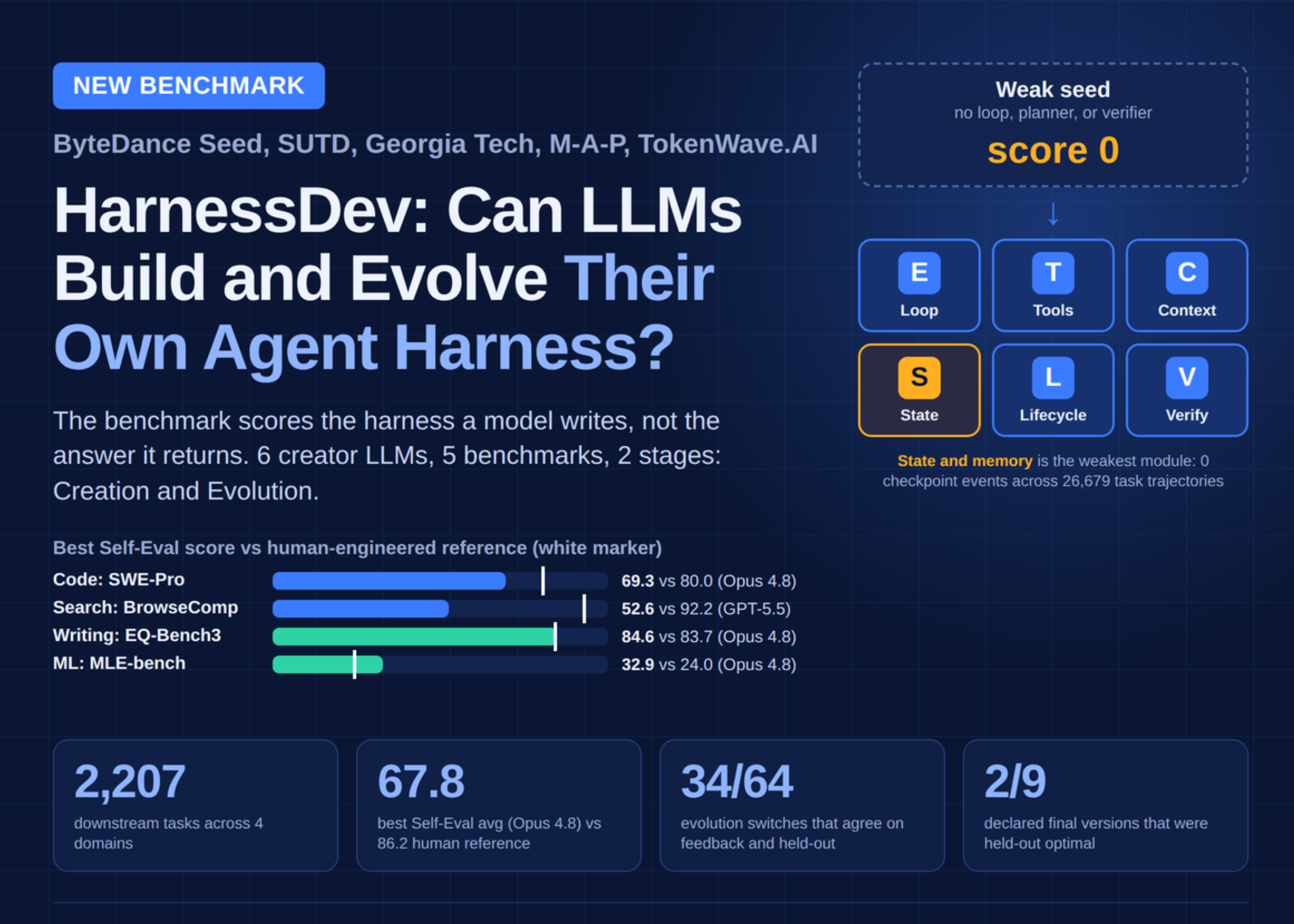
A groundbreaking joint empirical study titled HarnessDev—authored by research teams from ByteDance Seed, SUTD, Georgia Tech, M-A-P, and TokenWave.AI—has delivered a stark cold-shower reality check to software architects. Evaluating LLM-driven harness generation across 2,207 test instances (including SWE-bench Pro, Terminal-Bench 2.1, MLE-bench, EQ-Bench3, and BrowseComp), the research proves that self-generated harnesses suffer from severe structural brittleness and extreme architectural bloat.
Key Empirical Findings:
- The Generalization Ceiling: Only 53.1% (34 out of 64 generated harness modifications) generalized successfully to unseen environments. Almost half of all automated harness adaptations overfit strictly to local task prompts.
- The Dead Code Trap: Out of 108 evaluated functional components in self-generated harnesses, 18 components—representing 100% of generated memory and state management classes—were completely inactive dead code that never executed at runtime.
- Code Volume vs. Utility Paradox: Total lines of code added (exceeding 17,111 lines across test runs) showed almost zero correlation with task success ($r = 0.13 \text{ to } 0.26$). In contrast, revision iteration frequency ($r = 0.57$) and minimalist code generation were the sole predictors of runtime performance.
+-----------------------------------------------------------------------------------+
|                         HarnessDev Evaluation Breakdown                           |
+-----------------------+-----------------------+-----------------------------------+
| Metric / Component    | Observed Value        | Structural Consequence            |
+-----------------------+-----------------------+-----------------------------------+
| Generalization Rate   | 53.1% (34 / 64)       | High fragility on unseen workloads|
| Dead Code Abstractions| 100% of Memory/State  | Pure token bloat, zero activation |
| Code Volume Correl.   | r = 0.13 - 0.26       | Extra code does NOT equal quality |
| Revision Loop Correl. | r = 0.57              | Rapid micro-retries drive success |
+-----------------------+-----------------------+-----------------------------------+
Technical Anatomy: Creation vs. Evolution and the Dead Code Breakdown
The HarnessDev framework structures autonomous harness engineering into two distinct operational phases: Creation and Evolution.
 [ Phase 1: Creation ]
    └── Bare-bones execution loop (Passive, zero-state control flow)
            │
            ▼
 [ Phase 2: Evolution ] ◄── (10 Iteration Budget)
    ├── Probe Stage: Runs 2 x 5-task evaluation batches
    ├── Execution Analysis: Captures failure logs & runtime traces
    └── Micro-Revision: Refines harness code based on feedback
1. The Creation Phase
The LLM initializes an agent harness from scratch. To prevent premature hallucination of execution paths, the process begins with a completely passive execution loop containing zero retry mechanisms or complex state abstractions.
2. The Evolution Phase
The system executes an iterative loop capped at 10 update budgets. In each cycle, the harness undergoes two 5-task probe evaluations. Feedback from stdout, stderr, and test assertion logs is fed back into the model to trigger code revisions.
Rabomaru 🐶⚡ Says: “When LLMs are asked to write harness code, they act like junior engineers who read a design patterns book! They automatically generate massive
StateTracker,VectorMemoryStore, andRetryContextclasses. But because there are no explicit runtime triggers connecting these classes to the main loop, 100% of these memory components end up sitting completely unexecuted in production! Code minimization isn’t just aesthetic—it’s operational survival! 🐶⚡”
Why Models Hallucinate Dead Abstractions
Large language models are pre-trained on millions of open-source repositories rich in Object-Oriented Boilerplate. When tasked with solving complex agent failures, models over-index on structural pattern matching. Instead of fixing a single conditional check in a bash execution wrapper, models generate end-to-end event-driven state machines that are never instantiated or invoked inside the primary event loop. This leads to massive context token inflation and exponential API latency.
Empirical Reality: Benchmark Divergence and the 53.1% Generalization Ceiling
Across the 2,207 instances tested, LLMs exhibited extreme domain variance when allowed to engineer their own agent harnesses. While models achieved state-of-the-art results in specific structured reasoning domains, they collapsed catastrophically in open-ended web browsing and multi-step bash execution.
+-----------------------------------------------------------------------------------+
|              HarnessDev Performance vs. Human Reference Benchmarks                |
+--------------------+-------------------+--------------------+---------------------+
| Benchmark Target   | Reference Baseline| Claude Opus 4.8    | Performance Shift   |
+--------------------+-------------------+--------------------+---------------------+
| EQ-Bench3          | 83.7              | 84.6               | +0.9 (Surpassed)    |
| MLE-bench          | 24.0              | 32.9               | +8.9 (Surpassed)    |
| SWE-bench Pro      | 80.0              | 67.8 (Self-Eval)   | -12.2 (Degraded)    |
| BrowseComp         | 92.2              | 52.6               | -39.6 (Collapsed)   |
+--------------------+-------------------+--------------------+---------------------+
The Minimization Advantage: Gemini 3.1 Pro
On Terminal-Bench 2.1, Gemini 3.1 Pro captured top-tier performance not by constructing complex multi-file harnesses, but by modifying a mere 1,006 lines of precise, low-level wrapper code. In contrast, models that emitted over 17,000 lines of cumulative harness additions frequently crashed due to unexpected parameter mismatches in their own unverified helper functions.
For engineers running local hardware benchmarks or isolated sandboxes requiring scalable GPU concurrency, cloud platforms like RunPod ($0.20/hr~) offer cost-effective container runtimes to isolate and profile agent loop executions under strict memory constraints.
Production Implementation: Harness Evaluation Pipeline with Circuit Breaker
To evaluate agent harness code without falling into infinite adaptation loops or accumulating dead abstractions, production engineering systems require a strict evaluation wrapper. The script below demonstrates how to invoke and benchmark harness execution using an explicit circuit breaker and streaming failure control.
Prerequisites and Setup
git clone https://github.com/EQ-bench/eqbench3.git
cd eqbench3
pip install -r requirements.txt
Production Harness Execution Wrapper
import asyncio
import sys
import logging
from typing import Dict, Any
import aiohttp

logging.basicConfig(level=logging.INFO, format="%(asctime)s [%(levelname)s] %(message)s")

class HarnessExecutionBreaker(Exception):
    """Raised when harness modification limits or failure thresholds are breached."""
    pass

class RobustHarnessRunner:
    def __init__(self, max_revisions: int = 10, timeout_seconds: float = 30.0):
        self.max_revisions = max_revisions
        self.timeout_seconds = timeout_seconds
        self.revision_counter = 0
        self.circuit_open = False

    async def execute_probe_task(self, session: aiohttp.ClientSession, task_payload: Dict[str, Any]) -> Dict[str, Any]:
        if self.circuit_open:
            raise HarnessExecutionBreaker("Circuit breaker OPEN: Aborting harness execution.")

        try:
            async with session.post(
                "https://api.openai.com/v1/chat/completions",
                json=task_payload,
                timeout=self.timeout_seconds
            ) as response:
                if response.status == 429 or response.status >= 500:
                    logging.warning(f"Upstream API error HTTP {response.status}. Retrying via backoff...")
                    await asyncio.sleep(2.0)
                    return {"status": "degraded", "code": response.status}

                data = await response.json()
                return {"status": "success", "data": data}
        except asyncio.CancelledError:
            logging.error("Task execution cancelled by runtime supervisor.")
            raise
        except Exception as e:
            logging.error(f"Harness execution anomaly detected: {str(e)}")
            return {"status": "failed", "reason": str(e)}

    async def run_evolution_cycle(self, tasks: list):
        async with aiohttp.ClientSession() as session:
            for task in tasks:
                if self.revision_counter >= self.max_revisions:
                    logging.info("Max revision budget reached. Halting modification loop.")
                    break

                self.revision_counter += 1
                logging.info(f"Executing probe iteration {self.revision_counter}/{self.max_revisions}")
                result = await self.execute_probe_task(session, task)
                logging.info(f"Probe execution result: {result['status']}")

if __name__ == "__main__":
    dummy_tasks = [
        {"model": "gpt-4.1-mini", "messages": [{"role": "user", "content": "Run harness test probe 1"}]},
        {"model": "gpt-4.1-mini", "messages": [{"role": "user", "content": "Run harness test probe 2"}]}
    ]
    runner = RobustHarnessRunner(max_revisions=5)
    try:
        asyncio.run(runner.run_evolution_cycle(dummy_tasks))
    except KeyboardInterrupt:
        sys.exit(0)
Enterprise Decision Framework: Self-Evolution vs. Static Harness Architecture
When choosing between building static, human-engineered agent frameworks versus deploying LLM self-evolving harnesses, software architects must weigh trade-offs across cost, reliability, and maintenance overhead.
| Architectural Attribute | Static Hand-Crafted Harness | Self-Evolving LLM Harness (HarnessDev Model) |
|---|---|---|
| Generalization Reliability | High (95%+): Fixed operational semantics | Low (53.1%): Susceptible to task overfitting |
| Maintenance Overhead | High: Requires manual engineer updates | Low: Model auto-adapts to error traces |
| Code Efficiency | Optimal: Zero dead code abstractions | Poor: High accumulation of dead state classes |
| Token Cost / Invocation | Deterministic & Low | Variable & High (up to 10x revision attempts) |
| Best Use Case | Production API services, deterministic DB access | Open-ended research exploration, automated bug hunting |
Actionable Engineering Rules for Agent System Architecture:
- Ban Pre-Allocated State Classes: Do not prompt LLMs to construct state managers or context wrappers before a runtime failure explicitly demands them.
- Enforce Micro-Revision Loops: Cap evolution iterations at 10 and prioritize fast iteration speed over multi-file structural re-architecting.
- Prune Inactive Code Automatically: Implement static analysis AST sweeps post-generation to eliminate any state class or tool wrapper lacking a direct caller in the primary execution loop.