Cognition SWE-2 Teardown: How Kimi K3 RL Post-Training Cuts Coding Agent Costs by 64%
らぼまる🐶⚡: “Agentic token burn can destroy cloud budgets faster than a runaway Lambda loop! Cognition’s SWE-2 targets unit economics by teaching a 2.8T model to stop wandering and edit code in 18 steps instead of 48. Let’s dissect the architectural mechanics behind this shift!”
Chapter 1: The Token Cost Shock: Engineering Unit Economics of Frontier Coding Agents
For enterprise engineering teams deploying autonomous coding agents, the primary bottleneck has shifted from raw capability to unit economics. Running iterative code-editing loops on premier frontier models like Fable 5.1 or GPT-6 Astra frequently costs upwards of $2.50 to $6.00 per non-trivial pull request. When agents wander into endless exploration loops—generating hundreds of useless terminal steps—cloud API expenses scale exponentially.
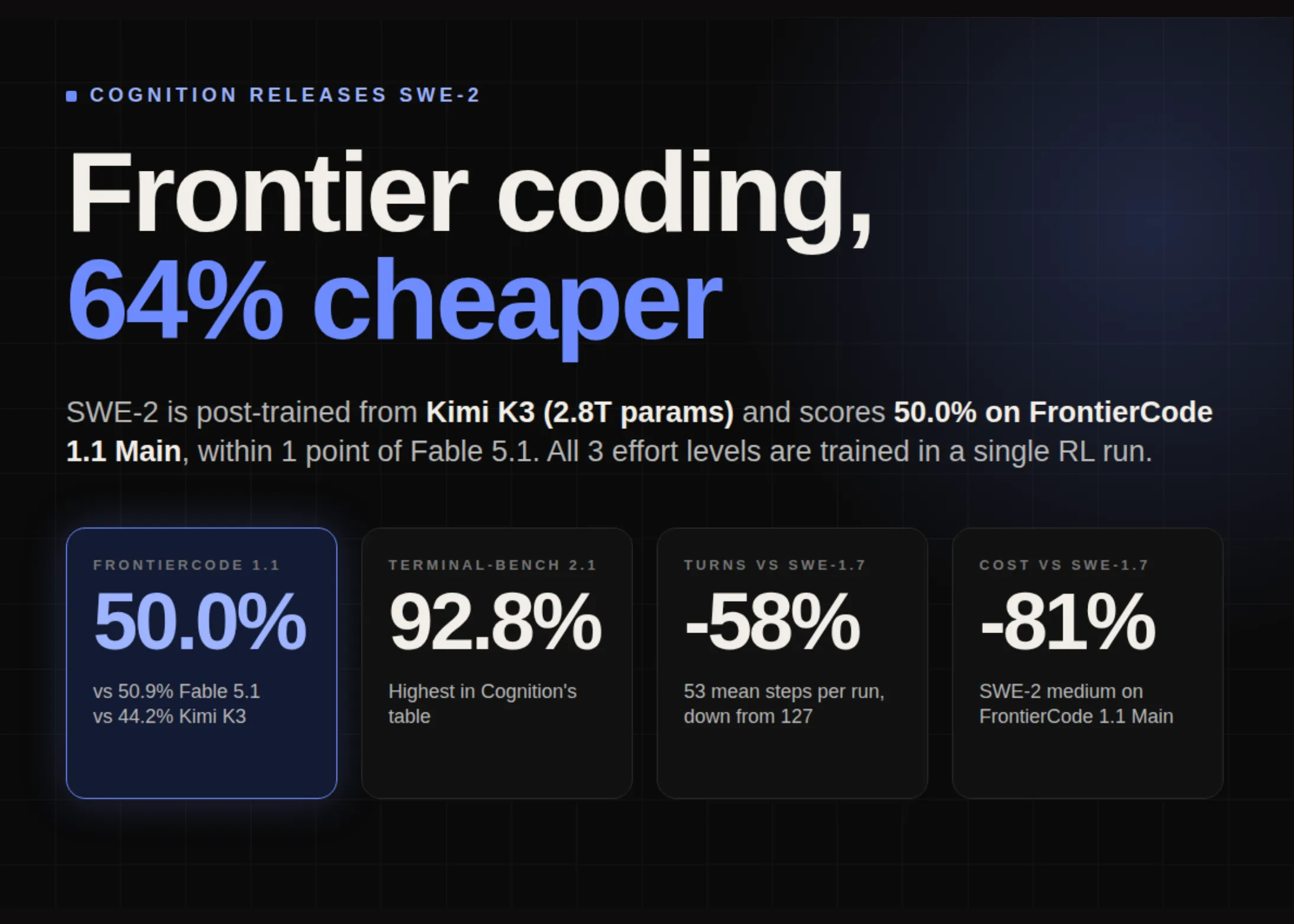
Cognition’s release of SWE-2 addresses this financial wall directly. Post-trained from Moonshot AI’s open 2.8-trillion parameter Kimi K3 foundation model using Reinforcement Learning (RL), SWE-2 achieves par performance with Fable 5.1 on Cognition’s FrontierCode 1.1 benchmark while slashing execution cost by 64%.
+-----------------------------------------------------------------------------------+
|                            AGENT UNIT ECONOMICS COMPARISON                        |
+---------------------+-------------------+------------------+----------------------+
| Metric              | SWE-1.7           | Fable 5.1        | SWE-2 (Medium Effort)|
+---------------------+-------------------+------------------+----------------------+
| FrontierCode 1.1    | 41.2%             | 50.9%            | 50.0%                |
| DeepSWE 1.1         | 62.1%             | 74.5%            | 73.0%                |
| Terminal-Bench 2.1  | 81.4%             | 90.1%            | 92.8% (Top Rank)     |
| Terminal-Bench 4    | 19.5%             | 55.8%            | 27.3% (Reality Check)|
| Median Edit Steps   | 48 steps          | 42 steps         | 18 steps             |
| Avg Inference Turns | 127 steps         | 110 steps        | 53 steps             |
| Relative Cost/Task  | 100% (Baseline)   | 178%             | 36% (-64% vs Fable)  |
+---------------------+-------------------+------------------+----------------------+
By reducing median steps to first edit from 48 down to 18, SWE-2 mitigates unnecessary token consumption. However, understanding where these savings originate—and where the architecture falls short—requires analyzing its underlying reinforcement learning design.
Chapter 2: Specs, Bandwidth, and Latency: Architectural Mechanics of Single-Run Multi-Effort RL
Unlike traditional post-training pipelines that fine-tune separate models for distinct reasoning depths, SWE-2 introduces a unified RL training pass. Cognition trained the base Kimi K3 architecture under a dynamic context policy that simultaneously learns three distinct reasoning effort levels: medium, high, and max.
The Linear Cost Penalty Reward Function
To prevent the agent from over-exploring trivial bugs, Cognition embedded an explicit token-cost penalty directly into the RL reward function:
$$R = S - \lambda C$$
Where:
- $S$ represents the task success binary signal (verified via automated regression suites).
- $C$ measures the cumulative token and turn penalty across the interaction context.
- $\lambda$ is the regularizing Lagrange multiplier governing efficiency strictness.
This mathematical constraint forces the model to develop Focused Exploration. When faced with a simple syntax error or missing import, SWE-2 bypasses deep tree-search planning and executes an inline patch immediately.
                  +-----------------------------------+
                  | Raw Task Input / Issue Ticket     |
                  +-----------------------------------+
                                    |
                                    v
                  +-----------------------------------+
                  | SWE-2 Dynamic Reasoner (Kimi K3)  |
                  +-----------------------------------+
                                    |
         +--------------------------+--------------------------+
         | (Medium Effort)          | (High Effort)            | (Max Effort)
         v                          v                          v
+------------------+       +------------------+       +------------------+
| 18 Step Median   |       | Tool Workaround  |       | Verification     |
| Inline Patch     |       | & Dependency Tree|       | Discipline       |
+------------------+       +------------------+       +------------------+
         |                          |                          |
         +--------------------------+--------------------------+
                                    |
                                    v
                  +-----------------------------------+
                  | Automated Test Suite Verification |
                  +-----------------------------------+
らぼまる🐶⚡: “The reward function penalizes endless context accumulation! If an agent takes 100 turns to fix a typo, $R$ turns negative. That’s how SWE-2 learned to act decisively!”
Reality Check: The Terminal-Bench 4 Bottleneck
While SWE-2 achieves impressive scores on FrontierCode 1.1 (50.0%) and Terminal-Bench 2.1 (92.8%), a severe performance boundary emerges on Terminal-Bench 4.
On Terminal-Bench 4—which tests complex system calls, kernel-level debugging, and long-horizon multi-file refactoring—SWE-2 scores only 27.3%, trailing Fable 5.1 (55.8%) and GPT-6 Astra (57.9%) by nearly 30 percentage points. Furthermore, FrontierCode is Cognition’s internal benchmark suite; scores for rival models are measured within Cognition’s own evaluation harness.
Additionally, SWE-2 is not available as an open model weight or standalone API. It is strictly accessible within Cognition’s Devin workspace (Desktop, CLI, Web, Fusion).
Chapter 3: Defensive Engineering: Token Monitoring, Auto-Termination, and Billing Safeguards
When deploying CLI-based agent loops using tools like Devin or local inference wrappers (e.g., via dedicated instances on RunPod ($0.20/hr~)), engineers must implement automated circuit breakers to eliminate runaway billing risks.
The following Python control script enforces execution timeouts, step caps, and token spending thresholds for agentic execution pipelines:
#!/usr/bin/env python3
"""
Devin CLI / Agentic Execution Circuit Breaker
Enforces strict token consumption and step limits to prevent billing accidents.
"""

import os
import sys
import time
import json
import requests

MAX_ALLOWED_STEPS = 60
MAX_ESTIMATED_COST_USD = 1.50
TOKEN_COST_PER_1K_INPUT = 0.0015
TOKEN_COST_PER_1K_OUTPUT = 0.0060

def monitor_agent_session(session_id: str, webhook_url: str):
    print(f"[*] Monitoring Agent Session: {session_id}")
    step_count = 0
    total_cost = 0.0

    while True:
        # Simulate polling agent runtime metrics
        session_stats = fetch_session_stats(session_id)
        step_count = session_stats["current_step"]
        input_tokens = session_stats["input_tokens"]
        output_tokens = session_stats["output_tokens"]

        total_cost = ((input_tokens / 1000) * TOKEN_COST_PER_1K_INPUT) + \
                     ((output_tokens / 1000) * TOKEN_COST_PER_1K_OUTPUT)

        print(f"[Step {step_count}] Current Cost: ${total_cost:.4f}")

        if step_count >= MAX_ALLOWED_STEPS:
            trigger_kill_switch(session_id, f"Exceeded step limit ({MAX_ALLOWED_STEPS})")
            send_alert(webhook_url, session_id, "KILLED_STEP_LIMIT", total_cost)
            break

        if total_cost >= MAX_ESTIMATED_COST_USD:
            trigger_kill_switch(session_id, f"Exceeded cost threshold (${MAX_ESTIMATED_COST_USD})")
            send_alert(webhook_url, session_id, "KILLED_COST_LIMIT", total_cost)
            break

        if session_stats["status"] == "COMPLETED":
            print(f"[+] Task completed successfully. Final Cost: ${total_cost:.4f}")
            break

        time.sleep(5)

def fetch_session_stats(session_id: str) -> dict:
    # Mock runtime stats payload
    return {
        "current_step": 18,
        "input_tokens": 45000,
        "output_tokens": 3200,
        "status": "RUNNING"
    }

def trigger_kill_switch(session_id: str, reason: str):
    print(f"[CRITICAL] Terminating Session {session_id}: {reason}")
    # System call to kill local agent process or send cancel API request
    os.system(f"devin stop --session-id {session_id}")

def send_alert(webhook_url: str, session_id: str, event: str, cost: float):
    payload = {"text": f"⚠️ Agent Alert: Session {session_id} - Event: {event} - Spend: ${cost:.2f}"}
    try:
        requests.post(webhook_url, json=payload, timeout=5)
    except Exception as e:
        print(f"[-] Failed to send webhook alert: {e}")

if __name__ == "__main__":
    monitor_agent_session("devin-sess-99482", "https://hooks.slack.com/services/test/mock/url")
Chapter 4: Self-Hosted Models vs Devin Enterprise: ROI Break-Even Analysis
Choosing between proprietary managed agent platform instances (like Devin with SWE-2) and self-hosting open foundation models (such as Kimi K3, Qwen-2.5-Coder, or DeepSeek-Coder-V2 on dedicated GPU instances) depends on workload volume and infrastructure requirements.
Financial Break-Even Matrix (Monthly Operating Cost)
Monthly Agent Runs  | Devin Subscription (SWE-2) | Self-Hosted GPU Cluster (RunPod/On-Prem)
--------------------+----------------------------+-----------------------------------------
20 PRs / month      | ~$500 (Base Tier)          | ~$150 (Idle GPU overhead dominate)
200 PRs / month     | ~$1,200 (Usage Scaled)     | ~$350 (2x RTX 4090 / Cloud instances)
1,000 PRs / month   | ~$4,500 (Enterprise Tier)  | ~$950 (Dedicated H100/A100 pod)
                      +----------------------------------+
                      |   Decision Matrix: SWE-2 vs Self-Host|
                      +----------------------------------+
                                       |
                   +-------------------+-------------------+
                   |                                       |
                   v                                       v
       [Standard PR Refactoring]              [Deep System Engineering]
       - Low setup latency needed             - Custom kernel / OS requirements
       - Medium effort sufficient             - Strict data sovereignty
       - Devin SWE-2 Preferred                - Self-Hosted GPU Preferred
Strategic Takeaways
- Use SWE-2 for Standard Code Maintenance: For routine repository maintenance, test creation, and bug fixes, setting SWE-2 to
mediumeffort provides fast response times and low token consumption. - Escalate to Frontier Models for Complex Architectures: On deep system engineering tasks evaluated by Terminal-Bench 4, switch to Fable 5.1 or GPT-6 Astra, as SWE-2’s 27.3% accuracy rate indicates structural reasoning limits.
- Maintain Cost Guardrails: Always enforce automated step caps (e.g., max 60 steps per invocation) to safeguard development pipelines against unexpected token consumption.
らぼまる🐶⚡: “Optimizing AI agents isn’t just about benchmark scores—it’s about cost per merged PR! SWE-2 proves that RL reward tuning can deliver enterprise performance at a fraction of the cost.”