🐶 Labomaru’s Quick Take & Specs
“Decoupling heavy context reading from frontier models can drop your Claude Code API bills from hundreds of dollars down to mere pocket change! 🐶⚡”
- 🚀 Tool Type: Pro Tips / Decoupled Architecture (MCP Server)
- 💰 Cost & Pricing: DeepSeek API ($0.22/M input tokens) + VPS (~$5/mo) vs $300+ Frontier API costs
- 💻 System Requirements: Python 3.10+, SearXNG VPS (SSH tunnel), Claude Code CLI
- 🎯 Best For: Full-Stack Developers, Codebase Researchers, AI Power Users
- ✨ Key Benefit: Cuts repetitive context-reading API fees by up to 99% while maintaining Claude 3.5 Sonnet reasoning!
1. Key Takeaways & Real-World Impact (Before vs. After)
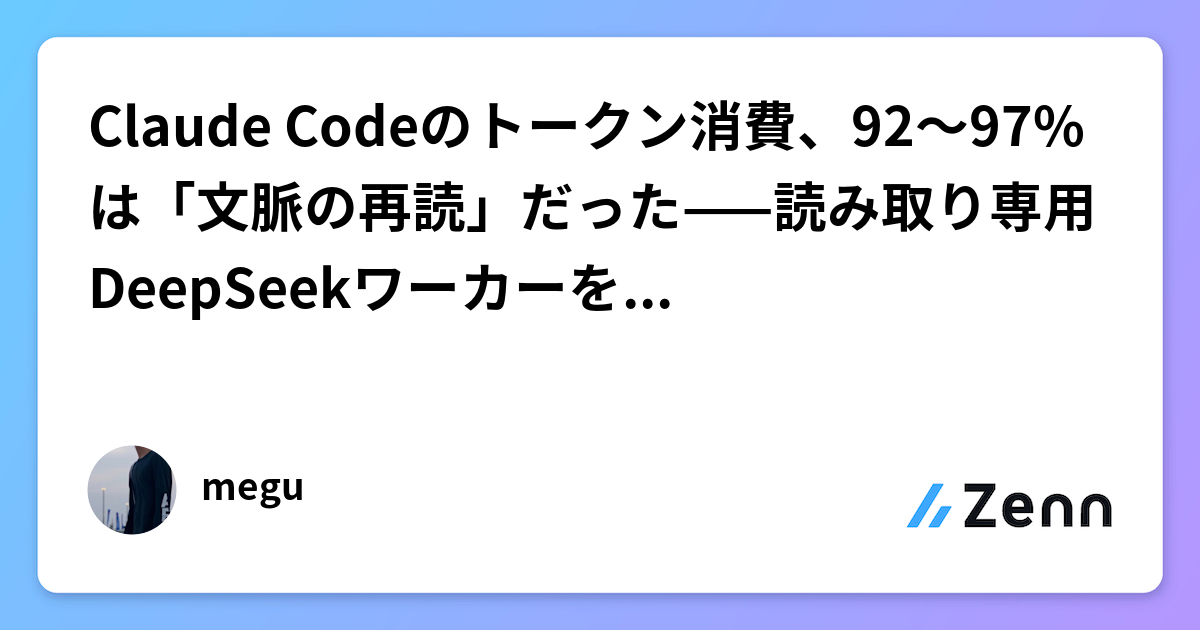
Detailed billing analysis of AI coding assistants reveals a startling reality: 92% to 97% of Claude Code API expenditures are consumed by context re-reading (cache reads and writes), while deep reasoning and thinking tokens account for less than 0.4% of total costs. Every time an agent scans a codebase, executes search tools, or inspects files across turn-based interactions, expensive frontier model tokens are repeatedly burned on raw context ingestion.
By implementing a Read-Only DeepSeek Worker MCP Server, developers can decouple the “reading and searching” phase from the high-tier reasoning engine. The lightweight DeepSeek worker handles standard directory globs, greps, file reads, and web searches locally, returning a tightly compressed summary (capped at 12,000 characters). Claude Code receives only high-density, pre-digested context.
- Before: Exhaustive codebase exploration and research tasks directly billed to frontier APIs racked up $392.00 per session. Heavy multi-file development runs consistently cost between $100.00 and $680.00.
- After: The exact same deep research tasks drop to $4.50 total (a 98.8% cost reduction), with the DeepSeek worker accounting for just $0.09. Complex development tasks fall to $19.40 (worker API fee $0.39). Monthly worker operational fees consistently stay below $2.00.
2. Hardware Specs, Pricing & Setup Complexity
- Local Hardware Requirements: Minimal. Any modern developer machine (macOS/Linux/Windows) capable of running Python 3.10+ and the Claude Code CLI.
- Network & VPS Setup: Requires a low-cost virtual private server (VPS, 1-2 GB RAM) hosting SearXNG (accessible locally over an SSH tunnel at
127.0.0.1:8888) to provide privacy-focused web search capabilities for the worker. - API Pricing: DeepSeek V4 Flash input rates sit at $0.22 per million tokens, making iterative file loops virtually free compared to frontier model pricing.
- Setup Difficulty: Advanced (Developer CLI). Requires configuring a custom Model Context Protocol (MCP) server in Python, managing SSH tunneling for search, and integrating tool definitions into your Claude configuration.
3. Comparative Analysis & Benchmarks (Including Break-Even Analysis)
The table below demonstrates how the decoupled MCP architecture compares against naive frontier API usage and local hardware-bound execution.
| Architectural Metric | Standard Claude Code | Decoupled DeepSeek MCP Architecture | Local RAG Pipeline (Ollama / Llama 3) |
|---|---|---|---|
| Context Reader Model | Claude 3.5 Sonnet | DeepSeek V4 Flash (Read-Only) | Local Llama 3 (8B / 70B) |
| Context Cost Distribution | 92%–97% on cache re-reading | 99% displaced to $0.22/M worker | $0 (bounded by local electricity/VRAM) |
| Research Task Benchmark | ~$392.00 | ~$4.50 (99% Savings) | $0.00 (Requires $2k+ GPU setup) |
| Heavy Dev Task Benchmark | ~$100.00 – $680.00 | ~$19.40 (Worker cost: $0.39) | Bottlenecked by context window |
| Context Output Payload | Uncompressed file dumps | Strictly capped (<12k chars) | Vector chunk top-k fragments |
| Monthly Maintenance Fee | Variable ($50–$1,000+) | ~$2.00 API + ~$5.00 VPS | Fixed local hardware cost |
| Break-Even Point | Baseline | Immediate (1st large codebase scan) | 6–12 months of daily heavy coding |
4. Pro Tips & Maximum Productivity Recipes
Decoupled MCP Worker Architecture Pattern
To build an effective context-compressing worker, restrict its tooling strictly to read-only capabilities and enforce rigid output payload limits in standard Python:
# MCP Worker Tool Definition Example (Python Standard Library)
import subprocess, json

MAX_SUMMARY_CHARS = 12000

def execute_read_only_search(query: str, path: str = ".") -> str:
    """Performs local grep/glob search and returns compressed context."""
    try:
        # Run lightweight local grep search
        result = subprocess.run(
            ["rg", "--ignore-case", "-n", query, path],
            capture_output=True, text=True, timeout=10
        )
        raw_output = result.stdout

        # Enforce strict context compression before returning to Claude
        if len(raw_output) > MAX_SUMMARY_CHARS:
            return raw_output[:MAX_SUMMARY_CHARS] + "\n[Context truncated: 12k limit reached]"
        return raw_output
    except Exception as e:
        return f"Search failed: {str(e)}"
Workflow Optimization Recipes:
- Read-Only Safety Guardrails: Completely omit file-write, patch, or command-execution functions from the worker MCP server. This guarantees that cheap auxiliary models can never accidentally mutate code or corrupt local git branches.
- SearXNG Privacy Tunnel: Route web fetch tasks through a local SSH tunnel (
ssh -L 8888:127.0.0.1:8888 user@your-vps) to bypass rate limits and external tracking while executing live technical documentation searches.
5. Potential Pitfalls & Edge Cases
- Small Codebase Overhead: For quick single-file edits or trivial fixes under 50 lines, initiating the worker tool loop adds minor latency overhead without producing noticeable cost savings.
- Search Precision Risk: If the DeepSeek worker crafts suboptimal grep or glob patterns, it might truncate relevant code files before delivering the final <12k character summary to Claude 3.5 Sonnet. Clear search queries are required.
- VPS Maintenance: Setting up and maintaining self-hosted SearXNG instances requires basic system administration skills (Docker/Python, SSH key management, uptime monitoring).
6. Final Verdict & Cost-Benefit Recommendation
- Immediate Adoption Recommended: For software architects, full-stack engineers, and open-source contributors working on codebases spanning hundreds of files. Decoupling context reading via a DeepSeek MCP worker pays for itself on day one, reducing multi-hundred-dollar API bills down to standard operational pocket change.
- Wait & See: For hobbyists working on lightweight scripts or developers who already rely exclusively on local open-source LLMs with dedicated high-VRAM workstation hardware.