Executive Summary: Overcoming Context Rot and Goal Loss in Long-Horizon AI Agents
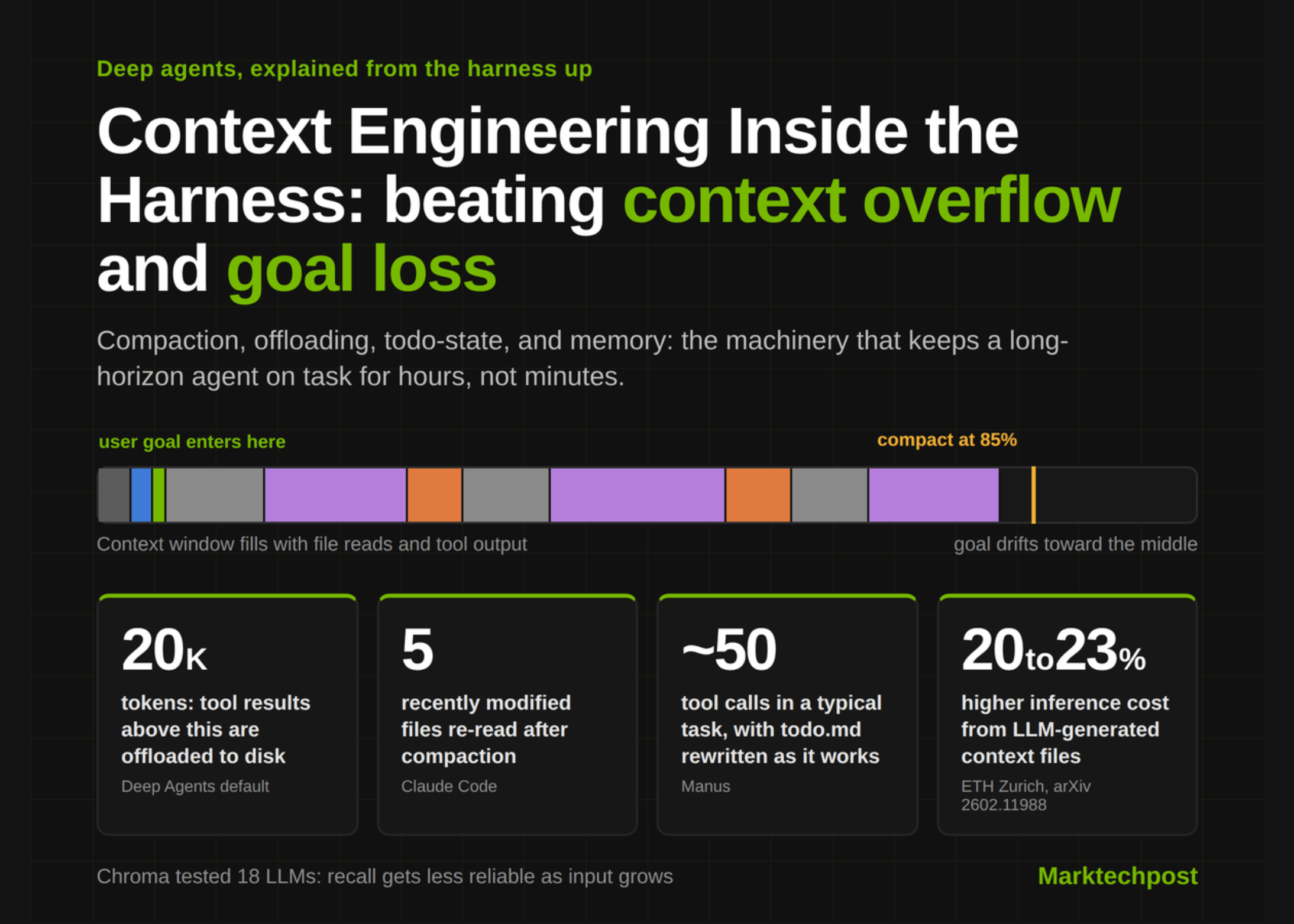
When scaling autonomous AI agents to long-horizon tasks—defined as operations requiring 50+ sequential tool invocations spanning over an hour of continuous execution—the primary failure mode shifts from model reasoning capability to Context Rot. As the context window expands, raw model attention mechanisms degrade quadratically ($O(n^2)$ token interaction complexity). This dilution leads directly to Goal Loss, where models lose track of initial constraints and intermediate state invariants.
Raw token context extension (e.g., moving from 128k to 2M tokens) does not eliminate this problem; it amplifies inference latency and exponential API costs without solving middle-context retrieval failures. In production frameworks such as Manus, input-to-output token ratios frequently reach 100:1, meaning an unmanaged 50-step execution accumulates hundreds of thousands of redundant tokens.
To achieve deterministic execution, modern agent orchestrators (Claude Code, LangChain Deep Agents, Amazon Bedrock AgentCore) delegate context control to an external Harness Layer. By implementing four explicit context engineering mechanics—Context Budgeting & Offloading, Compaction, Memory Strategy, and Todo-State Tracking—the harness compresses multi-hundred-thousand token trajectories into stable 1,000–2,000 token active contexts, reducing token re-transmission overhead by over 90%.
| Metric / Dimension | Monolithic Full-Context Trajectory | Harness-Managed Context Architecture |
|---|---|---|
| Input-to-Output Token Ratio | ~100:1 (Unbounded Growth) | ~10:1 (Bounded Active Context) |
| Subagent Task Execution Footprint | ~6,100 tokens raw context | ~420 tokens summarized pointer |
| Attention Saturation Threshold | ~85% window saturation triggers Context Rot | Capped at <50% via active offloading |
| Tool Schema Footprint | Static load of all MCP tool schemas upfront | Lazy load / dynamic schema resolution |
| System Fault Tolerance | Volatile in-memory crash vulnerability | SQLite WAL persistent state checkpoints |
Labmaru 🐶⚡: “Throwing 1 million raw tokens at an LLM attention head isn’t system engineering—it’s expensive noise! Real agent stability happens when the harness acts as an authoritative virtual memory manager, paging out heavy tool logs to disk and keeping the active context razor sharp!”
Harness Architecture: The 4 Core Context Mechanics
+-----------------------------------------------------------------------------------+
|                                 HARNESS LAYER                                     |
|                                                                                   |
|  +-------------------+    +--------------------+    +--------------------------+  |
|  | 1. Context Budget |    | 2. Context         |    | 3. Subagent Isolation    |  |
|  |    & Offloading   |    |    Compaction      |    |    & Memory Strategy     |  |
|  +---------+---------+    +---------+----------+    +------------+-------------+  |
|            |                        |                            |                |
|            v                        v                            v                |
|  [Tool Log > 20k Tok]     [Ctx Saturation > 85%]        [Raw Subtask Context]     |
|            |                        |                            |                |
|            v                        v                            v                |
|   Offload to Disk          Summarize Tool History       6,100 Tok -> 420 Tok Summary|
|   + 10-line Preview        to File Pointers             to Parent Context         |
+-------------------------------------+---------------------------------------------+
                                      |
                                      v
+-----------------------------------------------------------------------------------+
|                      4. Todo-State & MCP Schema Lazy Loader                      |
|                                                                                   |
|  - State Engine: Tracks pending, active, and completed sub-goals (SQLite WAL)     |
|  - MCP Tool Registry: Loads tool metadata dynamically only when invoked           |
+-----------------------------------------------------------------------------------+
1. Context Budgeting & Offloading
When a tool returns massive raw payloads (e.g., build logs, web scrapes, or grep results exceeding 20,000 tokens), injecting the entire string into the context window causes immediate attention bloat. The harness intercepts stdout/stderr before it reaches the model prompt. The full raw payload is written to persistent storage (e.g., ./workspace/.offload/log_104.txt), and the active context is updated with a 10-line truncated preview alongside an explicit file pointer path.
2. Context Compaction & History Pointerization
When session context usage reaches an architectural threshold (85% of target budget), the harness executes a compaction phase. Older conversational turns and tool call histories are summarized into structured milestone files. Historical turns are replaced with lightweight pointers, allowing the model to request specific details via filesystem access tools only when strictly required.
3. Memory Strategy & Subagent Isolation
Instead of executing secondary exploratory tasks within the main conversational thread, the harness spawns isolated Subagents. For instance, evaluating an external library documentation tree might consume 6,100 tokens of raw execution context within a child subagent. Once complete, the subagent returns a clean 420-token structured summary back to the parent agent, discarding the child context. Auto-memory files (such as MEMORY.md) are strictly managed with hard caps (e.g., top 200 lines / 25KB maximum).
4. Todo-State Management & MCP Lazy Loading
To prevent the agent from straying during long trajectories, the harness enforces a deterministic Todo-State tracking file (TODO.md). Before executing actions, the agent must read and update this state register. Furthermore, to avoid polluting the prompt with hundreds of Model Context Protocol (MCP) tool schemas, the harness registers only lightweight tool identifiers initially, fetching complete JSON schemas dynamically upon resolution.
Production Bottlenecks: Attention Budgets, Memory Footprints, and State Persistence
Transitioning agent harnesses from local prototypes to production enterprise infrastructure exposes three critical technical failure modes:
1. Process & Memory Footprint Management
Desktop-bound GUI runtimes bundling Electron with embedded web servers (e.g., Node.js / Hono) introduce substantial memory overhead (often exceeding 1.5GB base RAM before model inference). During long-horizon operations, child CLI tools or headless browser sessions (Playwright/Puppeteer) risk becoming orphaned background processes if the parent process exits unexpectedly. Production harnesses must implement explicit OS process group isolation and sub-process lifecycle hooks.
2. Resilience, Rollback Mechanics, and State Persistence
In-memory agent state representations are volatile. Network partitioning, API rate limiting (HTTP 429), or sudden container termination (SIGKILL) will wipe out execution progress. Production systems require transactional persistence using SQLite in WAL (Write-Ahead Logging) mode. Every context modification, offloaded file pointer, and todo-state transition must be written atomically to disk to enable instant crash recovery and state checkpoint rollbacks.
3. Physical Operational Constraints: Local Runtime vs. Headless Cloud
Executing long-horizon agents on developer desktops creates bandwidth constraints, sleep-state interruptions, and filesystem collision risks. Distributed agent execution requires decoupling the harness into containerized headless workers managed by orchestrators or dedicated cloud virtual machines to offload long-running compute workloads safely.
Production Implementation: Context Offloader and Circuit-Breaker Agent Harness
The following standalone Python implementation demonstrates a production-grade context management harness featuring payload offloading, subagent summary isolation, retry circuit-breakers, and cancellation protection.
import os
import sys
import json
import asyncio
import logging
from pathlib import Path
from typing import Dict, Any, List, Optional

logging.basicConfig(level=logging.INFO, format=