Executive Summary: Amazon’s Decoupled Agent Architecture & Operational Reality
When background AI agents execute long-running, multi-step workflows—such as analyzing repository pull requests, synthesizing cross-channel Slack discussions, or preparing financial audits—they inevitably encounter two fatal bottlenecks: context switching overhead and uncontrolled non-deterministic side effects.
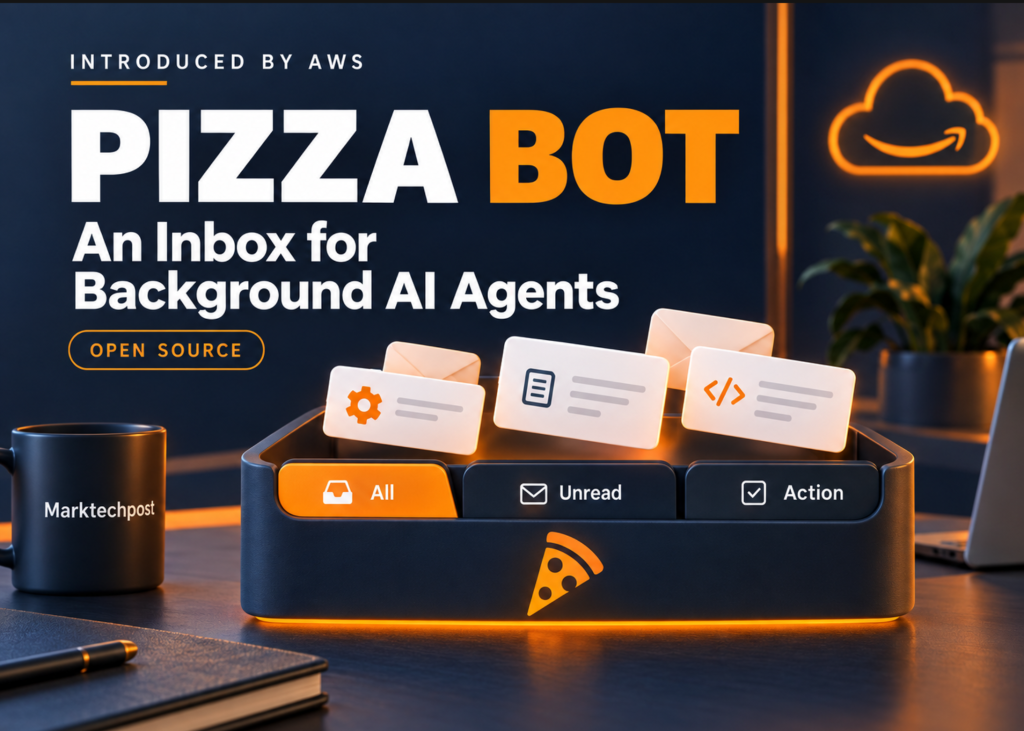
Amazon engineers have open-sourced Pizza Bot (pizza-bot-app/pizza-bot) under the Apache License 2.0. Rather than a closed AWS managed cloud service, Pizza Bot is a community-accessible agent orchestration inbox built on Node.js 24+, Hono, SQLite, and LangGraph. Battle-tested internally across more than 2,000 Amazon employees, Pizza Bot departs from ephemeral terminal logs and chaotic webhook scripts in favor of an email-inspired inbox paradigm—triage streams segmented into Unread, Action Required, and Completed.
+-------------------------------------------------------------------------+
|                        PIZZA BOT ARCHITECTURE                           |
|                                                                         |
| +-----------------------+        +------------------------------------+ |
| |  Clients (UI Layer)   |        |        Control & Safety            | |
| | Electron / React UI   |<------>| Human-in-the-Loop (HITL) Queue    | |
| | CLI / Web Browser     |        | SKILL.md Policy Enforcer           | |
| +-----------+-----------+        +-----------------+------------------+ |
|             |                                      |                    |
|             v                                      v                    |
| +---------------------------------------------------------------------+ |
| |                       Hono REST / WS API Server                     | |
| +-----------------------------------+---------------------------------+ |
|                                     |                                   |
|                                     v                                   |
| +---------------------------------------------------------------------+ |
| |               LangGraph / DeepAgents Runtime Engine                 | |
| |  +---------------------+  +------------------+  +-----------------+ | |
| |  | State Checkpointing |  | MCP Protocol     |  | Cron Deduper    | | |
| |  | (SQLite Persistence)|  | Client Runtime   |  | & Replay Guard  | | |
| |  +---------------------+  +------------------+  +-----------------+ | |
| +-----------------------------------+---------------------------------+ |
|                                     |                                   |
|                                     v                                   |
| +---------------------------------------------------------------------+ |
| |                      External Model Backends                        | |
| | Amazon Bedrock | Anthropic | OpenAI | Ollama (Local/RunPod GPU)     | |
| +---------------------------------------------------------------------+ |
+-------------------------------------------------------------------------+
🐶⚡ らぼまる: “Background agents aren’t merely LLMs wrapped in tool loops—they are distributed transactional state machines! Pizza Bot introduces a disciplined async human inbox, converting unpredictable agent actions into auditable state transitions.”
| Operational Dimension | Standard Webhook / Script Bots | Pizza Bot Open-Source Framework |
|---|---|---|
| State Persistence | In-memory or volatile Redis queues | SQLite WAL-backed LangGraph state checkpointer |
| Human-in-the-Loop | Blocking Slack prompts / timeout errors | Asynchronous Action Required interrupt queue |
| Tool Integration | Proprietary hardcoded REST adapters | Native MCP (Model Context Protocol) & .mcp.json |
| Cron Recovery | Cascading duplicate execution storms | Deterministic cron deduplication & catchup throttling |
| Deployment Target | Monolithic server or local desktop | Standalone Hono Server (Docker/K8s) or Desktop Electron |
Core Architecture: LangGraph State Graphs, Hono, and Sandboxed MCP Runtime
At the core of Pizza Bot is a decoupled architecture that isolates model reasoning from user interaction. The backend is powered by a high-throughput Hono API server managing WebSocket streams, REST endpoints, and task execution queues.
1. LangGraph State Persistence and Checkpointing
Pizza Bot implements a SQLite-backed state machine derived from LangGraph / DeepAgents. Every task thread maintains a linear log of immutable state checkpoints. When an agent requires human clearance (e.g., executing a database migration or writing to external APIs), the execution graph yields a SUSPENDED status, freezing the call stack until explicit operator resolution.
2. Human-in-the-Loop (HITL) Policy Enforcement via SKILL.md
Safety policies are completely decoupled from runtime model prompts. Each capability defines a SKILL.md manifest specifying interruptOn triggers and allowedDecisions:
- Approve: Resumes execution with the exact frozen state snapshot.
- Edit: Enables the human supervisor to mutate payload arguments before unfreezing execution.
- Reject: Gracefully aborts the execution sub-graph, recording an audit entry.
3. Model Context Protocol (MCP) Integration
Pizza Bot offers native compatibility with standard .mcp.json configurations (compatible with Claude Code and Claude Desktop). Teams can integrate existing MCP servers (filesystem access, GitHub API adapters, internal SQL drivers) without re-engineering tool definitions.
When pairing Pizza Bot with local open-weights reasoning models (e.g., via Ollama), leveraging cloud GPU instances on RunPod ($0.20/hr~) provides the necessary VRAM headroom while avoiding local developer hardware thermal throttling.
3-Vector Failure Modes: Process Lifecycle, SQLite WAL Resiliency, and Physical Constraints
Rigorous engineering evaluation requires looking beyond surface-level feature checklists. Based on static analysis of the codebase and system configurations, developers must account for three critical failure modes before deploying Pizza Bot to production:
[ Local Desktop Electron Runtime ]
   └── Bundled Hono Server (Binds to 127.0.0.1)
         └── App Close / OS Sleep --> In-Flight Step Terminated (Worker dies!)

[ Headless Production Topology ]
   └── Docker / Kubernetes Container Cluster
         └── Decoupled Hono Server + SQLite WAL / Distributed Volume Mount
               └── 24/7 Persistent Background Worker Threads
1. Process & Memory Footprint (Electron + Hono Co-location)
In default desktop mode, Pizza Bot bundles a Chromium-based Electron frontend and a Node.js 24+ Hono API server in the same OS session.
- Memory Overhead: The bundled desktop application consumes roughly 350MB–650MB of RSS RAM even in idle states. Under heavy tool calls with multiple browser or MCP child processes, memory pressure escalates rapidly.
- Process Termination Risk: Closing the Electron window sends a
SIGTERM/SIGINTthat shuts down the embedded Hono server. Any active, in-flight step (such as an LLM streaming call or a multi-minute build script) is abruptly severed.
2. Resilience & Rollback Mechanics (SQLite WAL vs SIGKILL)
- WAL Durability: Pizza Bot utilizes SQLite in Write-Ahead Logging (
PRAGMA journal_mode=WAL) mode for state checkpoints. If the host machine encounters an abrupt power loss or containerSIGKILL, the committed checkpoints remain uncorrupted. - In-Flight Step Rollback: While committed checkpoint nodes survive crashes, uncommitted in-flight step transactions cannot automatically rollback remote external side-effects (e.g., a partially executed third-party webhook or cloud API call). Systems architects must ensure all MCP tools adhere to strict idempotency.
3. Physical Operational Constraints (Desktop Limitations vs Headless Docker)
- Desktop Hibernation Hazard: When an operator’s laptop sleeps, background timers pause, causing scheduled tasks to back up.
- Cron Replay Protection: To prevent catastrophic token consumption upon wake-up, Pizza Bot enforces a single-execution catchup limit, discarding accumulated backlog iterations.
- Production Decoupling Requirement: True enterprise 24/7 background automation mandates containerizing the standalone Hono server into Docker/Kubernetes, detaching it from developer workstation lifecycles.
Resilient Production Setup & Minimal Server Harness
1. Repository Installation & Build
# Clone the official open-source repository
git clone https://github.com/pizza-bot-app/pizza-bot
cd pizza-bot

# Install dependencies and build components
npm install
npm run build

# Configure default LLM provider (Bedrock, Anthropic, or OpenAI)
export PIZZA_MODEL=anthropic:claude-3-5-sonnet-20241022
export ANTHROPIC_API_KEY=your_api_key_here

# Launch development instance
npm run dev
2. Standalone Hono Harness with Circuit Breakers & Disconnect Guards
To run Pizza Bot as a decoupled background service with graceful abort handling and rate limit separation (HTTP 429 vs 5xx):
import { Hono } from 'hono';
import { serve } from '@hono/node-server';

const app = new Hono();

// Middleware: Circuit breaker and client disconnect protection
app.use('*', async (c, next) => {
  try {
    await next();
  } catch (err: any) => {
    // Detect client disconnect during execution
    if (err.name === 'AbortError' || c.req.raw.signal.aborted) {
      console.warn('[Warning] Client connection aborted. Freezing checkpoint state...');
      return c.json({ error: 'Request aborted by client', status: 'suspended' }, 499);
    }

    const status = err.status || 500;
    if (status === 429) {
      console.error('[Circuit Breaker] Rate limit triggered from upstream LLM. Backing off...');
      return c.json({ error: 'Too Many Requests', retryAfter: 60 }, 429);
    }

    console.error(`[Unhandled Error ${status}]:`, err.message);
    return c.json({ error: 'Internal Engine Error', details: err.message }, status);
  }
});

app.get('/health', (c) => c.json({ status: 'ok', runtime: 'Node.js 24+' }));

// Bind to all interfaces for container deployment
serve({
  fetch: app.fetch,
  port: 3000,
  hostname: '0.0.0.0'
}, (info) => {
  console.log(`🍕 Pizza Bot Standalone Server running on http://${info.address}:${info.port}`);
});
Enterprise Decision Matrix & Production Checklist
                       [ Architectural Decision Tree ]
                                     |
          +--------------------------+--------------------------+
          |                                                     |
   Does your agent execute                               Does your agent require
   irreversible actions?                                 real-time streaming (<100ms)?
          |                                                     |
    +-----+-----+                                         +-----+-----+
    |           |                                         |           |
   YES          NO                                       YES          NO
    |           |                                         |           |
    v           v                                         v           v
[Adopt       [Use Pure                              [Use Websocket  [Adopt Pizza Bot
 Pizza Bot    Direct API                             Direct Sync     Decoupled
 HITL Inbox]  Pipeline]                              Pipeline]       Async Harness]
Production Readiness Checklist
- Decoupled Deployment Topology: The Hono API backend is containerized in Docker/K8s rather than running within the desktop Electron wrapper.
- Persistent Volume Mounts: The SQLite database file path is mapped to a durable, backed-up volume with WAL write permissions.
- HITL Policy Enforcement: Critical and destructive operations (file writes, database updates, cloud deployments) declare explicit
interruptOnpolicies inSKILL.md. - Idempotent MCP Tool Design: All downstream tools handle re-execution gracefully to survive process restarts and checkpoint resume cycles.
- Token Burn Safeguards: Configured strict
max_stepslimits per thread to prevent run-away agent recursion in unmonitored background tasks.