Context Engineering Inside the Harness: 4 Architectural Control Mechanisms That Prevent Context Overflow and Goal Loss
In the current AI landscape, model providers frequently tout massive million-token context windows as the ultimate solution for complex, multi-step software development and agentic workflows. However, production experience reveals a starkly different reality: simply feeding raw text into an expanding context window leads to performance degradation, soaring latency, and crippling API bills.
When autonomous agents execute long-horizon tasks—such as executing multi-file refactoring, analyzing codebase telemetry, or debugging deep stack traces—they encounter two critical systemic failures: Context Overflow and Goal Loss (often referred to as context drift or the Lost in the Middle phenomenon). Solving these operational bottlenecks requires shifting focus from model-level context scaling to harness-level context engineering.
This engineering teardown analyzes the four core mechanisms implemented in modern agentic architectures (such as Anthropic’s Claude Code CLI, LangChain Deep Agents, and Manus) that maintain deterministic control over context budgets.
The Context Window Myth: Why 1M+ Tokens Fail in Production
It is tempting to treat context windows as infinite RAM. However, Transformer attention mechanisms incur quadratic computationally expensive complexity ($O(N^2)$) relative to sequence length. As token counts scale, two operational failure vectors emerge:
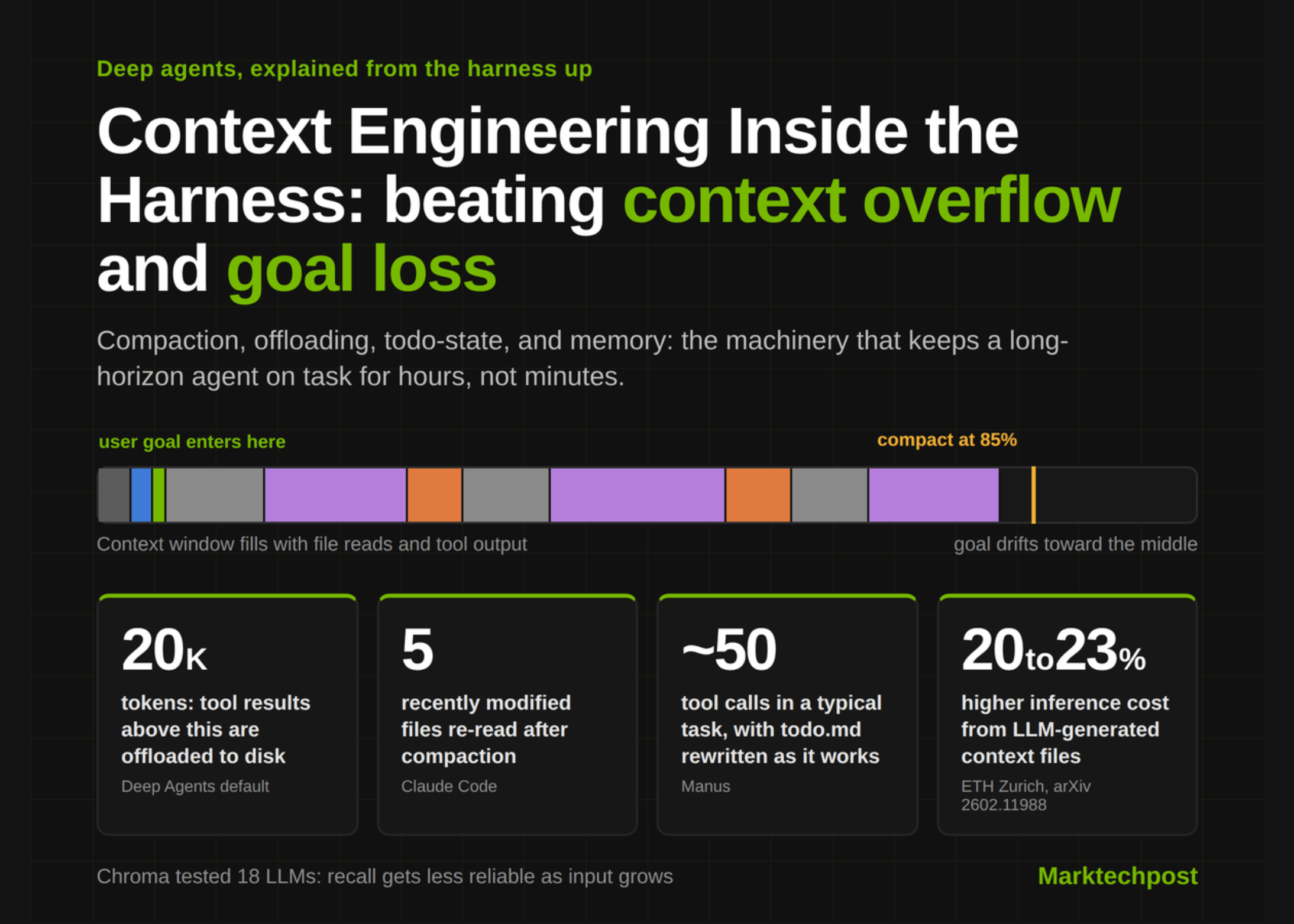
- Attention Rot & Lost in the Middle: Empirical studies across 18 leading LLMs (such as the Chroma Context Rot benchmark) demonstrate that retrieval accuracy and instruction compliance drop significantly when critical information resides in the middle 60% of a massive prompt context.
- Extreme Input-to-Output Asymmetry: Field telemetry from complex autonomous agents reveals an extreme ratio of raw data processing. A single task may execute 50 distinct tool calls, consuming tens of thousands of raw output tokens to generate a 200-token response—a 100:1 input-to-output consumption profile.
+---------------------------------------------------------------------+
|                   POINTER-BASED CONTEXT OFFLOAD                     |
+---------------------------------------------------------------------+
|                                                                     |
|  [ Tool Output > 20k Tokens ]                                        |
|               |                                                     |
|               v                                                     |
|  +--------------------------+    Save Full Log      +------------+  |
|  | Harness Interceptor      | --------------------> | Local Disk |  |
|  +--------------------------+                       +------------+  |
|               |                                                     |
|               v Replace with Pointer & Head/Tail Snippet            |
|  +---------------------------------------------------------------+  |
|  | Context Buffer: "[Truncated: see /tmp/tool_exec_8921.log]"     |  |
|  | First 10 lines ... Last 10 lines                              |  |
|  +---------------------------------------------------------------+  |
+---------------------------------------------------------------------+
🐶 Labomaru ⚡ (AI Systems & Architecture Lead): “Expanding context windows without budget management is like adding more RAM to fix a memory leak! The model gets bogged down in raw tool outputs and completely forgets the original user goal.”
If you are running local embedding models, agent memory indexers, or GPU-accelerated code processing alongside your agent environment, offloading compute to a dedicated instance like RunPod ($0.20/hr~) ensures your local host avoids resource contention.
Architectural Breakdown: The 4 Harness Mechanisms of Context Engineering
Rather than relying on model self-compaction, modern harnesses enforce strict deterministic controls outside the model inference loop.
1. Automated Filesystem Offloading & Pointer Swapping
When CLI tools execute commands (e.g., grep -r, pytest, or build logs) that output more than 20,000 tokens, the agent harness intercepts the stream. It writes the entire raw output payload to a temporary local disk file (e.g., /tmp/harness/outputs/res_89.log) and injects only a light pointer into the active prompt context alongside the first 10 and last 10 lines.
2. Threshold-Driven Context Compaction (85% Watermark)
When cumulative prompt utilization breaches an 85% watermark of the model’s operational limit, the harness triggers a compaction pass. Intermediate steps, verbose command-line executions, and old code diffs are purged and converted into high-density state summaries.
3. Sub-Agent Isolation & Summarization Return
For heavy exploratory sub-tasks, the primary agent delegates execution to isolated sub-agents. A sub-agent might consume 6,100 tokens testing multiple failing hypotheses; once resolved, it returns only a 420-token structured status report back to the primary parent agent context.
4. Lazy-Loaded Model Context Protocol (MCP) Schemas
Loading hundreds of MCP tool definitions up front consumes valuable context before the task even begins. Modern harnesses dynamically index tool definitions and inject detailed JSON schemas into the prompt only when the agent specifically requests that tool family.
import os
from typing import Dict, Any

class HarnessContextManager:
    """Manages context window budget by offloading heavy tool outputs to disk."""
    def __init__(self, max_inline_tokens: int = 2000, context_watermark: float = 0.85):
        self.max_inline_tokens = max_inline_tokens
        self.context_watermark = context_watermark
        self.storage_dir = "/tmp/harness_offload"
        os.makedirs(self.storage_dir, exist_ok=True)

    def process_tool_output(self, tool_name: str, raw_output: str) -> Dict[str, Any]:
        # Rough token estimation (approx. 4 chars per token)
        estimated_tokens = len(raw_output) // 4

        if estimated_tokens > self.max_inline_tokens:
            filename = f"{tool_name}_{abs(hash(raw_output))}.log"
            filepath = os.path.join(self.storage_dir, filename)

            with open(filepath, "w", encoding="utf-8") as f:
                f.write(raw_output)

            lines = raw_output.splitlines()
            head = "\n".join(lines[:10])
            tail = "\n".join(lines[-10:])

            compact_payload = (
                f"[TOOL OUTPUT TRUNCATED - Full output offloaded to {filepath}]\n"
                f"--- Head Snippet ---\n{head}\n"
                f"... [{len(lines) - 20} lines omitted to prevent Attention Rot] ...\n"
                f"--- Tail Snippet ---\n{tail}"
            )
            return {"status": "offloaded", "payload": compact_payload, "path": filepath}

        return {"status": "inline", "payload": raw_output}

# --- Actionable Integration Loop Example ---
if __name__ == "__main__":
    manager = HarnessContextManager(max_inline_tokens=500)

    # Simulate a massive tool output (e.g. 10,000 lines of pytest or build telemetry)
    simulated_build_log = "\n".join([f"Step {i}: verified dependency tree resolution OK" for i in range(1500)])

    # Intercept output before feeding back to the agent prompt
    intercepted = manager.process_tool_output("build_verifier", simulated_build_log)
    print(f"Harness Action: {intercepted['status'].upper()}")
    print("Injected Prompt Context:\n", intercepted["payload"][:350], "\n...")
Benchmark & Trade-off Matrix: Native Context vs. Harness Control
| Architectural Attribute | Native Large Context (Naive 1M) | Harness-Managed Context (Engineered) |
|---|---|---|
| Context Rot / Attention Drift | High (Degrades sharply past 100k tokens) | Ultra-Low (Maintains high-priority system goals) |
| Input Token Unit Economics | Linearly Scaling Cost (Extreme waste) | Compressed / Predictable (Up to 80% cost reduction) |
| Latency (Time-To-First-Token) | 5s - 15s+ prefill latency | < 1.2s prefill latency |
| Tool Schema Overhead | High (All schemas pre-loaded in prompt) | Zero Base Load (Schemas lazy-loaded on demand) |
| State Persistence across Crashes | Ephemeral (Lost on process crash) | Durable (Checkpoint files & SQLite WAL state) |
Failure Mode Teardown & Production Blueprint for Long-Horizon Agents
When deploying harness-managed context architecture into enterprise environments, technical leads must account for three structural failure modes:
1. Process & Memory Footprint Oversights
Combining desktop GUI interfaces (Electron apps or Hono/Node background servers) with aggressive local disk logging can create orphaned background workers. If an agent process is killed dirty (SIGKILL), disk logging temp paths can accumulate gigabytes of unindexed text logs, consuming host OS disk performance.
2. Resilience and Rollback Mechanics
Agent state management must rely on transactional persistence engines (such as SQLite with Write-Ahead Logging or lightweight checkpoint databases). If a network partition cuts off the LLM provider API mid-loop, the harness must roll back to the last clean context snapshot without re-executing non-idempotent tool operations (such as mutating git repositories or executing API calls).
3. Desktop CLI vs. Containerized Execution
While running CLI agents directly on host machines offers convenience, executing un-sandboxed shell commands risks irreversible filesystem modifications. Production systems should decouple the harness logic from the execution worker by enclosing state mutations within isolated Docker containers or ephemeral microVM environments.
🐶 Labomaru ⚡ (AI Systems & Architecture Lead): “By treating context as a tightly controlled compute budget rather than an infinite bucket, you guarantee deterministic execution and protect your deployment from runaway API costs!”
Recommended Practical Setup Guidelines
- Set hard caps on auto-memory state logs (keep system memory updates under 200 lines / 25KB).
- Enforce sub-agent context isolation for exploratory analysis tasks.
- Automatically offload raw outputs exceeding 20,000 tokens to persistent local disk pointers.